

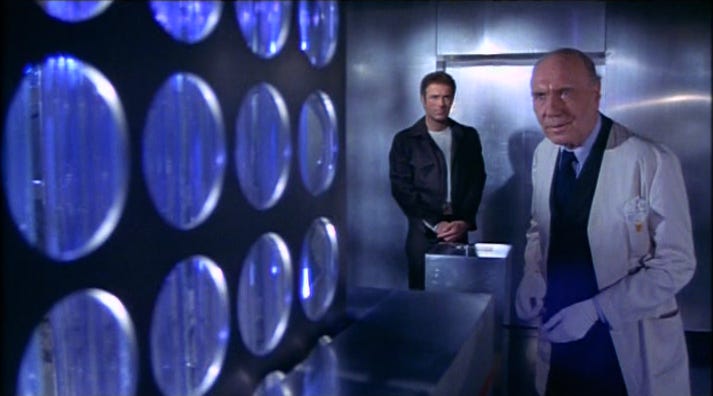
In Norman Jewison’s 1975 film Rollerball, an old librarian leads Jonathan E. into an archive run by a supercomputer everyone calls “the world’s file cabinet.” He is not proud of what he is about to show. He is embarrassed. Somewhere in the shuffling between machines, his staff has misplaced ”the whole of the 13th century”, every card that held it, gone, and nobody in the room can quite say how. He does not call it a catastrophe. He calls it distracting.
The joke depends on one fact the film never states outright: there was only one file cabinet. Comprehensiveness and a single point of failure are the same design, and losing a century inside it registers as an inconvenience rather than a catastrophe only because nothing here is real. Redundancy, not custodianship, is the only thing that has ever kept information from disappearing. Zero didn’t have any.
Anthropic’s handling of books was neither embarrassed nor an accident. The company hired Tom Turvey, who had run partnerships for Google Books, in February 2024; an internal memo that April described obtaining, in substance, every book in the world. Under a programme called Project Panama, print books were acquired in bulk, their bindings sliced away, the loose pages fed through scanners, and the paper thrown out. Court filings unsealed in the litigation put the spending in the tens of millions of dollars.
For most of what went through that process, redundancy survived: the books were common enough that destroying one copy left the text intact everywhere else. That is the case this essay has to address first, because it is the one the standard objection reaches for.
Alexandria
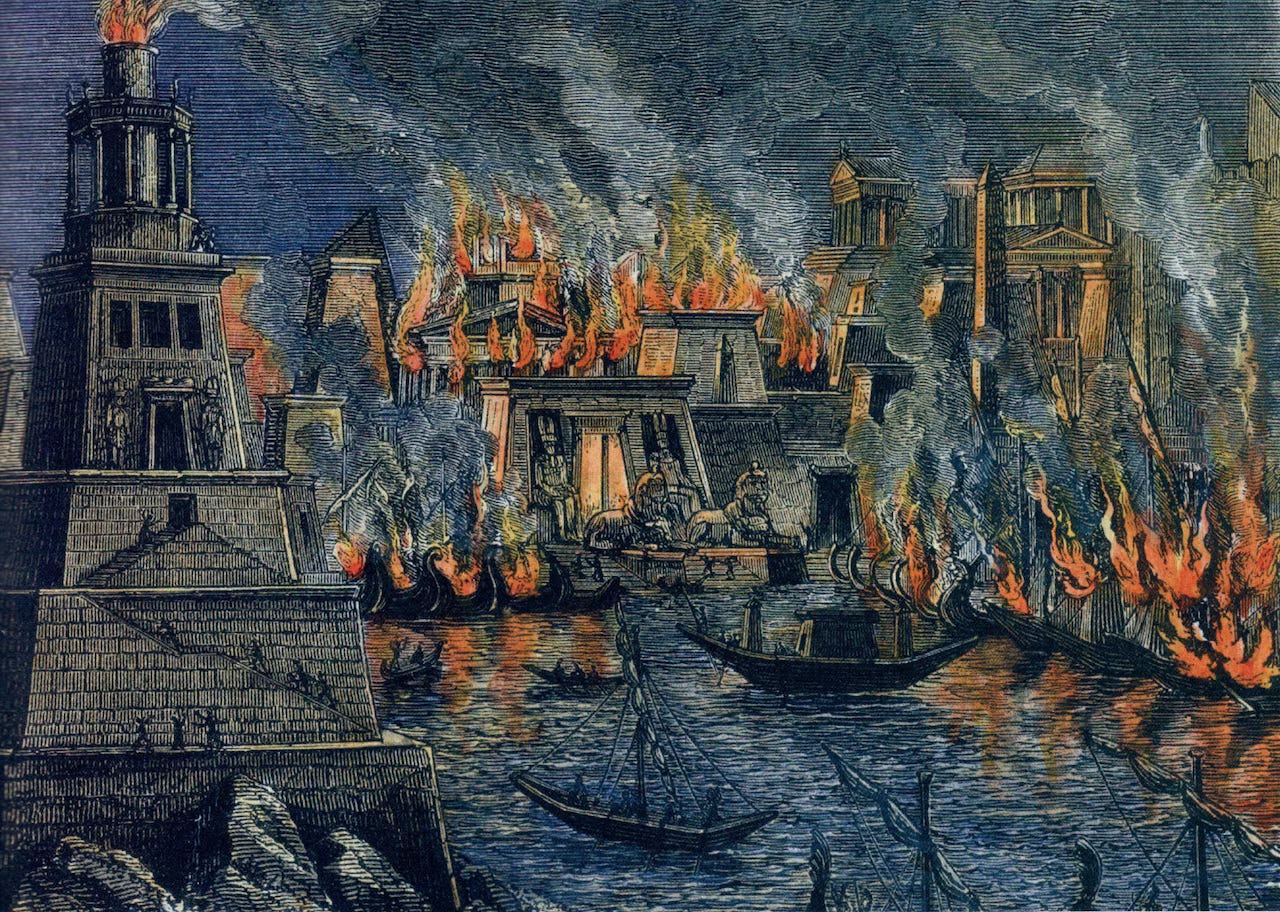
The comparison that followed was Alexandria, and for the bulk of Project Panama it fails on its own terms. Alexandria destroyed the only copies. Anthropic’s books were bought from wholesalers and second-hand dealers precisely because they were abundant, and the text of most of them survived the guillotine, cleaner, searchable, better indexed than before. A judge found the scanning fair use. Take that as given. For the common stock, no text was lost, because redundancy was never at risk. It does not hold for all of it. Reporting from 404 Media, an investigation that physically tracked a shipment with an Apple AirTag from a rare-books dealer to an Amazon-linked scanning facility, found that the acquisitions also included rare, antique, and out-of-print volumes, some of which exist only in physical form, meaning no digital copy exists anywhere else. That is not the same claim as there being only one physical copy left in the world; a book can be undigitized and still sit in library collections Anthropic never touched. But it is enough to break the assumption the abundant case rests on. Nobody outside Anthropic knows how many other copies of these specific volumes still exist, and destroying the one Anthropic bought removed the only copy whose survival can be confirmed. That is not “text survived” in the sense the essay’s opening claim relies on. It is text whose confirmed existence moved from public and redundant to private and singular, which is closer to what Alexandria did than the comparison is usually given credit for.
What Copyright Enforces
The instinct is to reach for copyright as the thing that should have prevented this. It can’t, because it was never built to. Copyright is government enforcement of a private property claim over a specific act, reproduction, not a duty to steward information across its actual life: creation, transmission, storage, decay, and whatever maintenance keeps it legible after that. Anthropic didn’t evade copyright to do what it did. It combined ownership of the physical copies, which let it destroy them, with a court’s finding that scanning and training on the resulting text was fair use. Money bought both halves of that combination, and everyone outside the transaction was excluded from all of it. The claim underneath this, that information can be property at all, doesn’t survive examination. Jefferson noticed the flaw in a letter to Isaac McPherson in August 1813: a person who receives an idea from another gains instruction without diminishing the giver. Stephan Kinsella states the mechanism directly: property rules exist to resolve conflicting claims over rivalrous resources, and information generates no such conflict, because one party holding it does not prevent another from holding the same sequence of words. Information cannot coherently be called property, because property answers a question, who gets the object when two parties want it, that information never asks.
Copyright is not a property right in an informational object, whatever the vocabulary around it implies. Wesley Hohfeld gave the precise structure in 1913: a claim-right entails a correlative duty; a power entails a correlative liability. Copyright is a claim-right over reproduction, with a duty not to copy falling on everyone else, and a power above that: the holder may license, price, assign, refuse, or do nothing. But copyright is not the only right in play when a physical book is destroyed. First-Sale Doctrine is a separate right, attached to ownership of the physical copy rather than to the copyright itself, and it lets whoever owns that copy dispose of it, including destroy it, without needing the copyright holder’s permission at all. Neither right, ownership or copyright, is a case of the copyright holder choosing to destroy their own creation. What the two share is only this: nothing in either one obligates anyone to keep a work in existence.
The Lifecycle Problem
Name what that leaves out, and the shape of the problem appears: copyright governs a single instant in information’s life, the moment of reproduction, and has nothing to say about everything before or after it. Nothing in the apparatus asks whether a work will still be legible in ten years, who is responsible for keeping it that way, or what happens when the party holding the only surviving copy stops caring. Orphan works make this failure visible without anyone having to choose anything. Where the holder cannot be found, the material is restricted and nobody collects anything: the duty not to copy continues, benefiting no one, while nothing obligates anyone to keep the work findable, legible, or intact. That is not a malfunction. It is the system running exactly as designed, with maintenance absent from the design because maintenance was never what the right was built to guarantee. Copyright, patent, trademark, and trade secrecy differ in duration, subject matter, and whether independent creation infringes at all; of the four, only copyright, patent, and trade secrecy concern what’s being argued here, since trademark exists to police deception about origin, not to restrict access to information.
Aaron Swartz
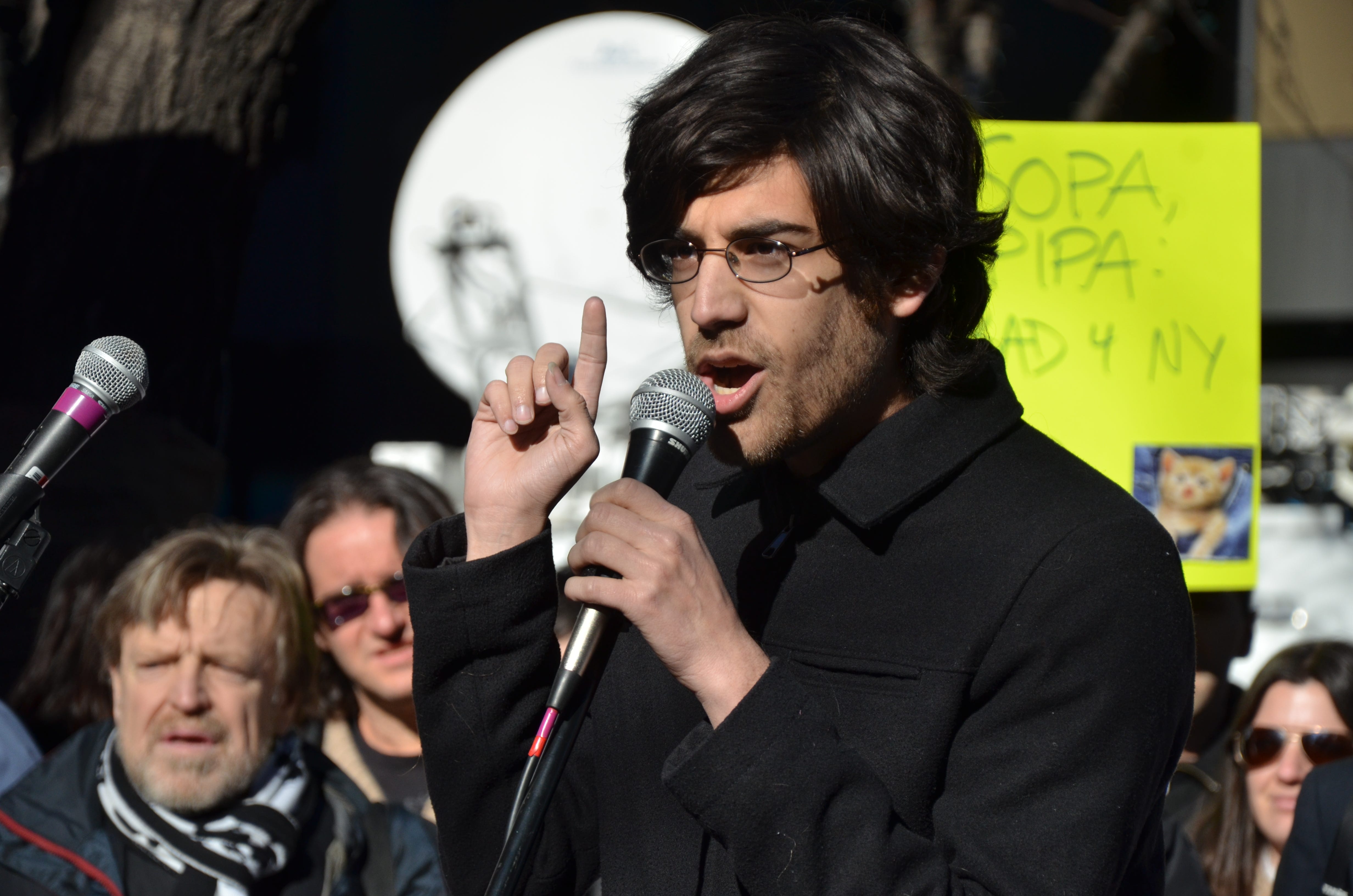
That enforcement power over information can outlive and override the wishes of whoever the law was supposedly protecting is not limited to copyright, and Aaron Swartz’s case shows it clearest precisely because copyright wasn’t the charge. He downloaded roughly 4.8 million articles from JSTOR over MIT’s network between September 2010 and January 2011. He was charged in July 2011 on four felony counts, then thirteen in September 2012, and the Justice Department’s own announcement put his exposure at up to thirty-five years and a million dollars. The counts were wire fraud and the Computer Fraud and Abuse Act. JSTOR wanted none of it. He returned the drives, and JSTOR stated publicly that its interest had been in securing the content; its lawyers contacted the prosecution repeatedly asking that the matter not proceed. It proceeded for eighteen further months anyway, with a plea demand of imprisonment. He died on 11 January 2013; the charges were dismissed three days later because federal charges abate on death. The rightsholder asked the state to stop, and the state kept going anyway, not under copyright but under statutes built for unauthorized computer access.
That is not evidence about copyright’s jurisdiction specifically. It is evidence of something this essay’s argument depends on more broadly: once an enforcement apparatus exists around controlling access to information, it develops an institutional life of its own, answerable to the state’s interest in prosecuting rather than to the party the law claims to serve. Copyright’s own enforcement runs on exactly that same logic, even where copyright is the statute actually invoked.
Article 19
Copyright is delegated public authority, and an authority requires justification proportionate to what it restricts. Article 19 of the Universal Declaration, and Article 19 of the Covenant that followed, protect the freedom to seek, receive, and impart information through any medium; every restriction on that freedom must be provided by law, necessary for a legitimate aim, and proportionate. The European Court accepted in Ashby Donald and in Neij and Sunde Kolmisoppi that copyright enforcement interferes with this freedom, and found the interference justified while leaving states a wide margin. In Eldred the Supreme Court declined to apply First Amendment scrutiny to copyright at all; Golan extended that reasoning further. No other restriction on the freedom to receive and impart information is permitted to make that argument. What Article 19 gestures toward but never delivers is the positive limb: a claim on provision, preservation, and disclosure. The UN High Commissioner’s office produced a dedicated report on access to information in January 2022, and many states point to the article among the grounds for freedom of information legislation they have since enacted. None of it reaches private holdings, or obligates anyone to keep information alive once it exists. The gap this essay keeps finding, a right to receive information with no corresponding duty to preserve it, is a limitation of what Article 19 was ever built to cover, not a defect in something it was meant to solve.
The Ruling and the Settlement
Judge Alsup’s order treated the purchased print books and the pirated downloads separately. Anthropic’s own internal planning documents describe the goal plainly: a central library of “all the books in the world,” retained “forever.” That was one library, containing both the purchased-then-destroyed books and pirated copies from Books3, LibGen, and Pirate Library Mirror together. Alsup split his ruling by acquisition method, not by the plan to keep the library itself. Converting a lawfully purchased copy, destroying the original, replacing it one-for-one with a digital file, was fair use. Retaining the pirated copies in that same library indefinitely was not. That distinction produced the settlement. Anthropic agreed to pay $1.5 billion, roughly 500,000 works at about $3,000 each, for the pirated portion alone. The settlement was agreed in September 2025, when Anthropic had just closed a round at a $183 billion valuation. Final approval came in July 2026, by which point a $65 billion Series H had priced the company at $965 billion, on a revenue run rate of $47 billion, with a confidential IPO filing four days later. Against the valuation at approval, the settlement is roughly 0.16 per cent. Against run-rate revenue, about twelve days. A fixed sum agreed with a company whose valuation quintupled between agreement and approval is a depreciating one.
Statutory damages run from $750 to $30,000 per work, rising to $150,000 for wilful infringement, indexed to the work, not to the resources of whoever infringed. Anatole France observed that the law in its majestic equality forbids rich and poor alike to sleep under bridges. The statutory schedule is that principle written into law: a fine only functions as enforcement when it is large relative to what the payer has, and for a company nearing a trillion-dollar valuation, $1.5 billion is a cost absorbed. Aaron Swartz was never offered anything resembling that arithmetic; on the Attorney General’s later account he was offered a range from zero to six months, with probation arguable, and no fine was ever the instrument. Both cases involved taking information without the rightsholder’s permission and without payment, though under different statutes for materially different conduct. The asymmetry in what each was offered was not proportional to that difference. What survives, past both the ruling and the settlement, is most of what was always meant to survive: a single, comprehensive, privately held archive, closed to every reader, library, and author outside the company that built it, exactly as planned before any court intervened.
Copyleft
The strongest objection to all of this is the GNU General Public Licence, which does not survive examination of how it works. Because the author holds the exclusive right, the author can impose conditions on anyone who copies, and reciprocity is enforceable only because refusing the terms leaves the copier with no right to copy at all. Stallman didn’t build an alternative to the exclusion right; he acquired it and pointed it the other way, on the assumption that copyright would persist. What the GPL demonstrates is that copyright can be made to compel ongoing availability, but only when a rightsholder actively chooses to wield it, case by case. Nothing in the apparatus makes that the default. Every enforcement of the GPL is an enforcement of copyright, and copyright’s default state, absent that specific choice, is what orphan works already showed: a duty that runs with no one obligated to act on it.1
The Upkeep Argument
The strongest case for copyright was never that ideas are property. Landes and Posner made that argument in 1989: accept the deadweight loss, accept restricted access, and argue the static loss buys a dynamic gain. It has a boundary it cannot cross: term extension applied retroactively to works already written, and no incentive operates backwards. A different version survives that objection. In 2003, Landes and Posner argued for indefinitely renewable copyright on grounds that had nothing to do with inducing creation: public-domain works may be used inefficiently through congestion externalities and weakened incentives to maintain them. That is an argument about the lifecycle problem directly, and it is the one that matters here. If upkeep is what justifies continuing protection, the institution should look different in specific, checkable ways, and it does not. Term would attach to maintenance rather than a fixed span. Renewal would require some showing of upkeep; abandonment would forfeit the right, with unexploited works reverting. None of that is how copyright operates. Copyright has had the chance to reorganise around the one justification that fits the problem it claims to solve. Nobody has taken it.
Zero
Kathryn James, the rare book librarian at Yale’s Lillian Goldman Law Library, has written about what Project Panama cost: there is no endangered list for printed works, no regulation of what counts as survival of the rare or unique, and no formal category treating a human-authored text as cultural heritage requiring protection. Copyright never created that category, because copyright was never built to. Anthropic’s library survived intact, for now, just as its own internal documents described from the start. For the out-of-print and rare volumes whose only confirmed surviving copy is the one Anthropic bought and destroyed, that single, unreachable archive is what redundancy has been reduced to. Nothing legally requires that it stay intact, verified, or even findable ten years from now. Zero lost a century and called it an inconvenience, because nothing in the joke was real. The mechanism is the one this essay’s own prior work already named: format death, invisible until it’s total, because digital storage carries no inscription commitment the way a physical original once did.
The Forgetting Machine

A clay tablet from 1750 BCE is perfectly legible. Your MSN Messenger conversations are gone. Your Foursquare check-ins are gone. The blog you kept in 2007 is probably gone. The private language your generation invented — the nudge, the status message aimed at one person, the Top 8 as a social contract — will die with the last person who remembers what i…
Copyright answered a question about who may reproduce a text at the moment it’s copied. It was never asked, and has nothing to say about, whether that text will still exist when someone finally needs it. Nobody has proposed an institution that does. The library did not burn this time. Nothing currently in force says it can’t.
Copyleft is not an exception to any of this. It doesn’t touch the root claim that information can be owned. It borrows that claim’s own enforcement machinery and points it at a different target: concentration and monopoly rather than access. The GPL still depends on copyright being enforceable exactly as this essay describes it, still runs entirely inside the property framing Jefferson and Kinsella’s argument rejects, and still requires someone to own the right in order to restrict what others do with it. It is a workaround built from inside the system it never questions, not an alternative to it: another loophole, using the same jurisdiction this essay has been naming throughout, not a correction to what that jurisdiction is.