The Forgetting Machine

A clay tablet from 1750 BCE is perfectly legible. Your MSN Messenger conversations are gone. Your Foursquare check-ins are gone. The blog you kept in 2007 is probably gone. The private language your generation invented — the nudge, the status message aimed at one person, the Top 8 as a social contract — will die with the last person who remembers what it meant. We are witnessing history in more detail than any civilization before us. We are losing it faster. These are not two problems. This is one problem, and it has a name: we built a machine that generates records and destroys them simultaneously, and we called it the internet. If a piece of data existed in a data center a thousand years ago but no one in 3026 can read it — did it ever exist? This piece is about why the answer matters — and about what it means that almost nobody is asking the question.
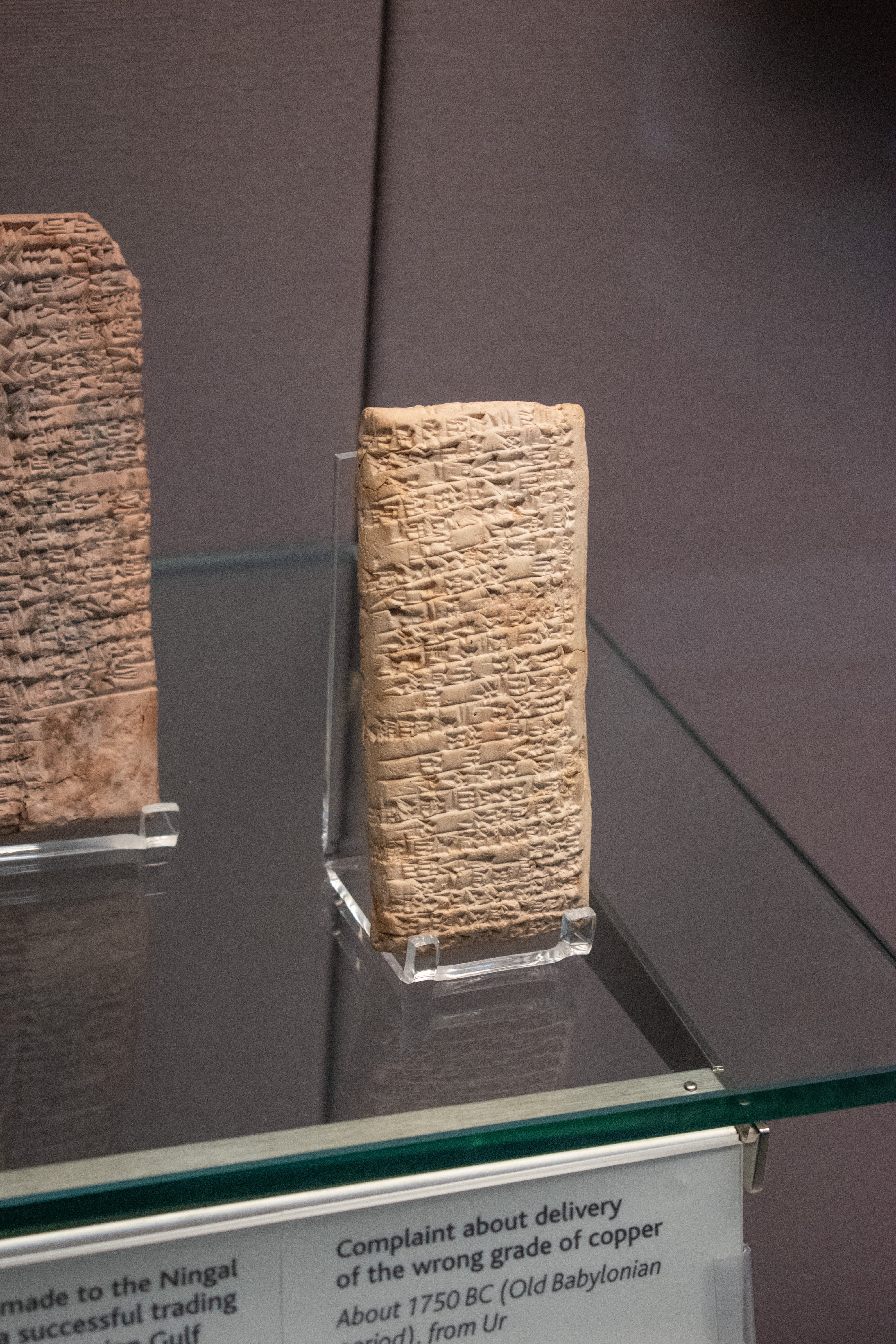
Somewhere in the archaeological record of ancient Mesopotamia, in a clay tablet dated to approximately 1750 BCE and now held in the British Museum, a merchant named Nanni addresses a copper trader named EA-Nasir in terms that any dissatisfied customer in 2026 would recognize immediately. The copper was substandard. The delivery was mishandled. The treatment of Nanni’s messenger was an insult that Nanni intends to take up with the relevant authorities. The tablet is sharp-edged, perfectly legible, and has been sitting in various forms of storage for approximately 3,750 years without requiring a single software update, a server maintenance window, or a subscription renewal. A scholar reads it today with no more technological apparatus than literacy in Akkadian cuneiform — a difficult skill, but a human one, requiring no hardware beyond a set of eyes and a trained mind.
Yelp, founded in 2004, is the closest functional equivalent our era has produced to Nanni’s tablet: a public platform for recording commercial transactions, evaluating the quality of goods and services, and holding merchants accountable to community standards. Its reviews are, in the most direct anthropological sense, the same artifact. They encode the same social function: complaint, commendation, the documentation of how commerce actually operated at the level of individual experience. The difference is not in what they record but in where they live. Nanni’s complaint lives in fired clay. Yelp’s complaints live in a proprietary database, on servers owned by a publicly traded company, accessible through an application layer that requires maintained software on maintained hardware connected to a maintained network, all of it contingent on the continued commercial viability of a single corporation whose obligation is to its shareholders rather than to the historical record. When Yelp goes — through bankruptcy, acquisition, pivot, or simple neglect — every review goes with it. Not gradually, not proportionally, but entirely, in the time it takes to execute a database deletion command. EA-Nasir’s complainant will be legible in 5026. Yelp’s will not survive in any accessible form without deliberate archival intervention — and no such intervention is currently planned. The question is not only why we are losing it. The question is whether digital data ever existed in a form that could survive.
But the contrast runs deeper than medium. It is in the relationship between experience and inscription that produced them. Nanni wrote after the fact, deliberately, because he judged the event worth the effort of recording. The lag between experience and inscription was not inefficiency; it was curation. It forced a decision: is this worth committing to clay? That decision was simultaneously a declaration of significance and a contribution to survival, because the resources spent on inscription were resources implicitly committed to the record’s preservation. Every scribe who pressed stylus to tablet was, without knowing it, making a preservation argument. The Yelp review, by contrast, is written at the moment of experience, automatically prompted by a notification, requiring no judgment about significance and committing no resources to survival. The lag has been eliminated. And with it, the selection judgment that the lag enforced — and the preservation commitment that went with the judgment — has been eliminated too. We record everything because recording costs nothing. We preserve almost nothing because preservation was never part of the architecture.
This is not a prediction about the future. It is a description of the present, and it has been the description of the present for thirty years.
Not a fire, a spreadsheet
If you are a millennial, your MSN Messenger conversations are gone. Not degraded, not partial, not recoverable with effort — gone, in the categorical sense that applies when a platform is shut down and the servers are wiped. The conversations in which you worked out who you were, negotiated your first relationships, said things you would later regret and things you would want to remember — those existed in a proprietary Microsoft protocol on Microsoft servers, and when Microsoft discontinued the service globally in April 2013, they ceased to exist. The server-side message history that Outlook.com had briefly preserved was quietly removed a few months later, in August 2013, with a notification that told users to move their logs manually before the deadline, which most people missed because most people do not read platform notices the way archivists read preservation orders. The conversations are gone. Not all of them were inconsequential. Some of them were with people who are no longer alive.
And then there was the blog you kept alongside those conversations. Between 2004 and 2011, MSN Spaces — later Windows Live Spaces — was, by measured audience, the largest blogging platform in the world. In April 2006, Microsoft’s own press release cited comScore figures showing 101 million unique monthly visitors, a number that made it larger than MySpace by that metric at the time. By late 2005 it already hosted 27 million blogs and 7.6 million active writers. It was integrated directly with MSN Messenger, so that when you updated your Space, your contacts’ messenger windows lit up with a notification — a gleam, Microsoft called it — telling them you had something new to say. It was the architecture of the social web before social networks had that name, and it ran as Microsoft’s flagship consumer community product for seven years. Then, in September 2010, Microsoft announced it would shut down. Users were offered six months to migrate to WordPress.com. Of the seven million profiles that existed at shutdown, approximately one million — fourteen percent — were successfully moved by the March 2011 deadline. The remaining six million blogs, representing years of personal writing accumulated across the whole arc of the mid-2000s internet, were deleted when the servers went offline on March 16, 2011. On Microsoft’s own support forums, years afterward, you can still find people who did not notice the closure in time. One of them wrote: ”I have almost 3 years of my teenage memories in it. During the moving time, I am busy with my thesis, and totally did not notice this.” It is the “totally” that gets me — the casual emphasis of someone writing about loss without quite knowing yet that it is loss. Archive Team attempted a rescue crawl and recovered a partial snapshot. The majority was not recovered.
Your Ask.fm profile, with whatever it recorded of your adolescent social life, has been substantially lost to multiple ownership changes and platform rebuilds. Your MySpace social graph, the network of relationships you built on the platform that first made social networking feel like a genuine social world, did not disappear in a single event but in three separate acts of commercial negligence that unfolded across nearly a decade, each one erasing a different layer of what made MySpace a record of human connection rather than just a music catalog. The 2010–2013 redesigns rewrote the platform’s database architecture so completely that legacy profile structures, custom HTML layouts, and comment threads from the original social network era were simply not carried forward: the self-expression that millions of people had spent hours constructing, the profile pages they had personalized down to the color of the scrollbar, dissolved as a byproduct of a corporate rebrand. In June 2013, without announcement, without warning, without offering users any export mechanism, MySpace deleted all user blogs and all private messages predating that date. Not some of them. All of them. The conversations people had conducted across years, the messages they had saved from friends who had since moved away or died, the written record of relationships that had mattered — erased in a routine database operation that MySpace did not consider significant enough to announce. Then in 2019, during what the company described as a server migration project, approximately 50 million songs from 14 million artists (everything uploaded between MySpace’s founding in 2003 and 2015) were permanently lost. The company apologized and suggested users consult their backup copies. In the aftermath, on Reddit, a parent wrote: ”My son recorded a song when he was 7 years old that his guitar instructor uploaded to his Myspace page. My son died 2 years ago, at the age of 20, and I would do anything to be able to hear it again.” There are no backup copies. The song is gone.
I have returned to that comment more than once while writing this.
None of this happened because of catastrophe. There was no fire, no flood, no equivalent of the destruction that erased the palace at Pylos. MSN Messenger died because Microsoft calculated that maintaining it was not worth the cost; Windows Live Spaces died because the company decided blogging was not its future. MySpace’s private messages were deleted because someone decided the storage cost of old conversations exceeded their value to the business, and the music was lost in a routine technical operation executed without adequate backup verification. These are not failures of extreme conditions. They are failures of ordinary commercial operation, the kind that happens routinely, repeatedly, and at scale, whenever the entity responsible for maintaining data decides maintaining it is no longer worth the expense. The OVH datacenter fire in Strasbourg in 2021, which destroyed servers hosting an estimated 3.6 million websites and years of unreplicated data, or the prospect of a regional conflict disrupting major cloud infrastructure — these are the scenarios we tend to imagine when we think about digital loss at scale. They are the wrong model. The right model is a product manager at a technology company opening a spreadsheet, calculating the cost of server maintenance against projected revenue, and scheduling a deprecation.
This is not digital dementia. Dementia is a malfunction — a memory system that should work and doesn’t, something broken that might, with enough care and resource, be repaired. That framing implies there is a patient to treat, a dysfunction to reverse, a system that was trying to remember and failed. The Forgetting Machine was not trying to remember. It forgot your Foursquare tips and your MSN Messenger archive and your Windows Live Spaces blog on schedule, correctly, because their retention period had expired. The system was not confused about what it was doing. It just did not send anyone a notification.
I lost the blog pages I wrote before 2010. I do not know precisely how many there were or what they contained, because I no longer have an inventory of what I have lost. This is the quality of digital loss that distinguishes it from physical destruction: when a building burns, there are ruins. When a library floods, there are waterlogged remnants. When a hard drive fails, there is at minimum the knowledge that something was there, the shape of an absence you can measure. When a platform deletes your data, there is nothing: no ash, no ruin, no evidence of prior existence. The gap is indistinguishable from empty space. I know I wrote those posts because I remember writing them, but the memory is the only record, and memory is not a format that persists across generations or admits of independent verification. To any future researcher, those posts did not exist. To any future researcher, the version of me that wrote them did not exist either.
Oral culture wearing digital clothes
But the deeper loss is not the data. The data, at least, is the kind of thing an archivist can in principle describe, quantify, and mourn with some precision. What cannot be archived — what was never recorded in any form that would survive the platforms or outlast the generation — is the grammar. The social grammar. The shared, unwritten, entirely practice-based understanding of what these platforms meant when people used them in ways the platforms had not designed and could not have anticipated, and which constituted the actual cultural life of the era.
MSN Messenger had a feature called the nudge. It sent a brief vibration shaking the other person’s chat window: a pulse, a prod, a way of saying I am here without saying anything. Its official function was to get someone’s attention. Its real social function was a distributed, context-dependent language that no one ever wrote down because everyone who needed to know it already knew it by osmosis. I started to write here that the platform destroyed this, and then I caught myself — the platform could not have destroyed what it never knew existed. The nudge was a feature. What people did with it was a culture. The company saw the feature. Nobody archived the culture. A nudge from a stranger was an intrusion. A nudge from a close friend was a joke. A nudge from someone you had feelings for was something else entirely: a small act of deliberate ambiguity, a way of making contact that was deniable if unwelcome and unmistakable if it wasn’t, carrying an emotional charge that existed entirely in the shared understanding between sender and recipient and nowhere else. The logs, where they survived, would show the timestamp and the fact of the nudge. They would not show what it meant. They could not. The meaning lived in the practice, in the accumulated cultural knowledge of a generation that understood instinctively what register a nudge from that person at that hour was operating in, and that knowledge was never committed to any medium that outlasts the people who hold it. (I am describing this from memory, which is exactly the point.)
The Now Playing feature broadcast whatever was playing in Winamp or Windows Media Player as a line in your status, visible to everyone on your contact list. This became a communication channel of considerable sophistication, operating almost as a private language across a public channel. You chose the song knowing who would see it. The sad song at two in the morning was a broadcast aimed at everyone and a message aimed at one, and both parties understood the distinction without it ever being stated. The slightly too specific lyric from the slightly too melancholy song was a form of indirect address: a way of saying something you could not say directly, protected by the plausible deniability of it just being what you happened to be listening to. The recipient knew. The sender knew the recipient knew. The knowledge that both parties knew and neither would acknowledge was itself part of the communication. None of this appears in any record. The status string, if it survived, would show a song title. It would not show the three previous songs the sender considered and rejected before settling on this one, or the fact that the recipient changed their own status within four minutes in a way that, to anyone else, meant nothing, and to the sender meant everything.
The MySpace profile was a statement of identity constructed with full awareness of who would read it, and the Top 8, the ranked list of your eight closest friends displayed publicly on your profile, was a social contract of extraordinary delicacy. Moving someone into the Top 8 was a declaration. Moving them up within it was a gesture. Moving them down was a slight significant enough to require explanation. Removing someone was a rupture, sometimes the opening move of a conflict, sometimes its conclusion. The profile song, chosen from whatever could be embedded, played automatically when anyone visited — aimed at whoever you were thinking about when you chose it, encountered by everyone, interpretable only by the person it was meant for. The careful selection and frequent updating of a display picture, the sequencing of a photo gallery, the strategic placement of comments on other people’s profiles — all of it constituted a layer of communication that was fluent, complex, emotionally freighted, and almost entirely undocumented. We did not write it down because it felt like the present. It felt as obvious and unremarkable as knowing what a facial expression means, and for the same reason: we had learned it by living in it, and you cannot archive the air you breathe.
I am aware this catalog of defunct software features will read, to some, as nostalgia for an era, or as an argument for pen and paper. It is neither. The question is not about medium preference. It is about whether the things we made had a form of existence that could outlast the commercial relationships that housed them. They did not. And even where the data survives, what is lost is not the record but the grammar of the record — the pragmatic layer of shared practice that made the text mean what it meant, which is not recoverable from transcripts alone. These are descriptions of a genuine oral culture — a set of shared practices with their own grammar, their own registers, their own pragmatics, transmitted entirely through participation and residing entirely in the living memory of the people who practiced it. Anthropologists have spent considerable institutional energy documenting vanishing oral cultures precisely because they understand that when the last speaker of a language dies, the language dies with them — not the words, which might be recorded, but the full communicative capacity of the language, which lives in the interaction between speakers and cannot be reconstructed from transcripts alone. Nobody sent an anthropologist to document the grammar of the MSN nudge because it felt like the present, too recent and too ordinary to be at risk, too universal among its users to seem like a specialist knowledge that might disappear. But it was oral culture wearing digital clothes, practiced by a generation now in their thirties and forties, and it will die with them. When the last millennial who remembers what it felt like to receive a nudge from someone they were afraid to call is gone, that knowledge is gone with them — completely, irrecoverably, in the way that the communicative life of every oral culture is gone when its last speaker closes their eyes.
The library that became television
The most precise account of what this transition felt like from the inside was written by someone who had the misfortune of being absent for the entire thing. Hossein Derakhshan, known in Iran as “Hoder” and credited with starting the blogging revolution in his country in 2001, was arrested in Tehran in November 2008 and sentenced to nearly twenty years in prison for things he had written on his blog. He served six years, one in solitary confinement, before being pardoned in November 2014. When he sat down at his laptop and reopened his blog, he found something he had not expected: not the web he had been jailed for, but something structurally different that had replaced the web he remembered without announcing itself as a replacement. He wrote about the experience in a 2015 essay, The Web We Have to Save, distinguishing two internets: the library-internet, decentralized and hyperlink-driven, where individual pages existed in relation to each other through voluntary links that constituted a kind of distributed attention; and the stream-internet, where content arrived in a linear, algorithmically curated flow that discouraged leaving the platform and treated a hyperlink as just another object, no more significant than a photograph or a reaction emoji. Blogs had been, in his phrase, cafes where people exchanged diverse ideas. What replaced them was television: passive, linear, centralized, calibrated to hold attention within a single platform rather than send it outward into a wider conversation. He had been imprisoned for six years for writing on his blog. When he emerged, the blog as a cultural form had been more thoroughly neutralized by the stream than the Iranian state had ever managed. The state could imprison him; the feed neutralized blogging without noticing it had done so.
Derakhshan was describing, in 2015, what an anthropologist a thousand years from now would call a transition between cultural infrastructures. The library-internet sustained a particular kind of communicative practice: deliberate, durable, discoverable, organized around individual voices and the connections they made to each other. The stream-internet sustained a different practice: ephemeral, algorithmic, optimized for the present tense. The shift was not announced. It happened while everyone was using both kinds of platform without realizing the second was replacing the first. What Derakhshan saw on his return is the kind of transition that, in any earlier era, would have taken centuries and would have been studied by generations of scholars trying to understand how a civilization’s mode of self-record had changed. It happened to us in roughly five years, between 2007 and 2012, and most of the people who lived through it did not notice it happening. The blogosphere itself — the actual posts, the linked conversations, the sense of an interconnected web of independent voices — is now substantially inaccessible: the hosting services are gone or unrecognizable, the link graph has rotted, and the cultural form has been replaced so thoroughly that younger users do not have a working concept of what it was. For Lena, this is a transition between recognizable cultural systems that occurred in her source population’s living memory and left almost no usable record of itself. The fact that we have Derakhshan’s essay is luck. Most cultural transitions of this scale leave even less.
The democratic promise
Consider Foursquare — not the company that exists today, which is a B2B location intelligence firm selling geospatial data to enterprise clients, but what it was between 2009 and approximately 2014: a platform on which millions of people documented, in real time, how they moved through cities. Users checked in at restaurants, bars, museums, parks, transit stations, and street corners, and they left tips: short, specific, experiential notes attached to physical locations. A good tip told you which seat in the café had the best light, which dish the kitchen actually did well, which entrance to use, which bartender to ask for. Collectively, the check-ins and tips constituted something with genuine anthropological weight: a living, crowd-sourced annotation of urban space, recording not just where people went but how they understood and valued the places they inhabited, how social life was organized around geography in the early smartphone era, what the texture of urban experience felt like in the first decade after always-on mobile internet changed the relationship between people and place. By 2013, Foursquare had logged more than three billion check-ins from over 30 million users. This was primary source material for understanding a cultural moment. It was also stored entirely in a proprietary database on Foursquare’s servers.
The platform pivoted. In May 2014 the social check-in layer was spun off into a separate application called Swarm, and in August of that year Foursquare 8.0 removed check-ins and the social layer from the main app entirely, pivoting to local search. By 2017 the company had pivoted again to enterprise location intelligence, selling its accumulated decade of movement data to corporations as an API product. The Foursquare City Guide app itself finally sunset on December 15, 2024; the web version followed on April 28, 2025. The millions of tips through which a generation of urban people annotated their cities were never transferred to any public archive, never donated to any research institution, never preserved in any form accessible to future scholars. What remains of Foursquare’s social era is a handful of academic papers published while the platform was active, some journalism from technology publications, and whatever individual users happened to screenshot or print. If those secondary sources do not exist, the fifteen years of collected data, insight, and cultural practice simply did not happen — not from the perspective of 3026, not from the perspective of any researcher who did not witness it directly. The culture existed; the record does not; therefore, for all practical historical purposes, the culture did not exist.
This is what the post-writing world means when it says that without records, you do not exist. After the invention of writing, the historically invisible were the poor, the illiterate, the people whose lives never generated documents that a scribal class considered worth preserving. We knew this was a distortion — we knew that the absence of records about ordinary people did not mean ordinary people had not lived full, complex, meaningful lives — but the distortion was structural and largely unavoidable. Digital technology appeared to offer a correction: for the first time in human history, ordinary people were generating durable records of their own experience, in their own words, at their own initiative, at scale. The democratization of historical presence seemed within reach. Every person with a smartphone was, in some sense, their own archivist, their own Pliny, leaving behind a primary-source account of their own daily life that future historians would be able to read.
The promise was false. The records are not durable. They are held under commercial terms that make them revocable at the discretion of platform operators, stored in proprietary formats that require the platform’s continued operation to render, and subject to deletion the moment maintaining them becomes commercially inconvenient. The democratization of record creation turned out to be the democratization of record loss: a system that generates unprecedented volumes of documentation and preserves almost none of it, applied universally and regardless of social class, so that the rich and the poor of 2026 will be equally invisible to 3026, not because they failed to document their lives but because the documentation was stored in a form that required a continuous commercial relationship to survive, and commercial relationships do not last a thousand years.
Substrate is not artifact
The ontological distinction matters and deserves to be stated precisely. A Post-it note on a wall is a physical fact. It occupies space. It has mass. It interacts with light in ways that make it visible to any observer in its physical vicinity without any intermediate apparatus. Its continued existence requires only that nothing physically destroys it: that no one removes it, that the wall does not burn, that the adhesive holds. It will yellow and curl at the edges and eventually become brittle, degrading in ways that are proportional, visible, and gradual, giving observers time to notice and respond. A message written on a physical note and placed in a box in an attic will be readable by anyone who opens the box in fifty years, or a hundred, without knowing anything about the technology of its creation. The interpretive requirement is minimal: literacy in the written language, and enough light to see the ink. This is so obvious it barely seems worth saying. It becomes worth saying the moment you try to apply the same logic to a tweet.
A post on a social media platform does not exist in this sense. It has no mass, occupies no space in any form accessible without the platform’s operational infrastructure, and is visible only to observers who possess the correct account credentials, the correct application, a working internet connection, and access to a device running software compatible with the platform’s current API. Its persistence depends not on physical stability but on a continuous series of commercial and technical decisions made by a corporation: the decision to keep the servers running, to maintain the database schema, to continue serving the API endpoint, to retain the data in an accessible format rather than archiving or deleting it. Remove any one of these conditions and the post becomes inaccessible, not gradually and proportionally but immediately and completely. There is no yellowing, no curling at the edges, no visible deterioration that signals impending loss and allows intervention. The post exists in one moment and does not exist in the next, and there is no physical residue in the space it occupied, because it occupied no physical space to begin with.
This is the sense in which digital data does not exist in the way a physical object exists, and it matters for archaeology because archaeological methods are premised on the recovery of physical residue. We know about Bronze Age trade networks because archaeologists have found the physical goods — the copper ingots, the tin, the ceramic amphorae, the glassware — in excavated sites across the Mediterranean. We know about Mycenaean palace administration because the fire that destroyed the palace baked the clay tablets into ceramic permanence, leaving a physical object that could be excavated, handled, and read three thousand years later. We know about Roman daily life because Vesuvius buried Pompeii under a layer of volcanic material that preserved organic as well as inorganic evidence — bread still in the oven, graffiti on the walls, the body casts of people who did not escape. Archaeological knowledge is knowledge recovered from physical residue, and physical residue is what digital data does not leave. I am reasonably certain about the mechanism here. I am less certain about the timeline — whether the silence arrives in a century or five is genuinely hard to predict. That it arrives is not.
Whatever the timeline, the mechanism is not in doubt. When the server that hosts a social media platform is decommissioned, it is typically wiped and either repurposed or disposed of. The data it contained does not leave a chemical signature in the soil, does not produce a sedimentary layer, does not generate physical artifacts that can be excavated and interpreted without the original software context. It simply ceases to be accessible, and the inaccessibility is permanent and invisible. There is no Herculaneum of the internet, no equivalent disaster that buries and thereby preserves the digital record in a form recoverable without the original infrastructure. Digital data that is not actively preserved is not slowly degrading toward eventual recovery. It is gone.
The old philosophical question asks whether a tree falling in a forest with no one present makes a sound. The tree, at least, leaves the fallen trunk. Its fall was a real event — the compression waves propagated through the air, the soil was disturbed, the canopy broke, the decay began. Only its perception was absent. A botanist arriving a decade later can reconstruct that a tree fell, approximately when, approximately how. The event is recoverable from physical evidence because the event left physical evidence. Digital data, when its system fails, leaves nothing comparable — not the sound, not the trunk, not the soil disturbance. It does not go unheard. It ceases to have been information at all. The arrangement of charge states that constituted the data reverts to matter the moment the interpretive system that made it readable is gone. The tree’s silence was circumstantial: someone present would have heard it. The data’s silence is structural: no presence at the right moment would have helped, because the conditions required for reading have themselves ceased to exist. The tree fell and was not heard. The data was not merely unheard — it was, in the only sense that matters for historical recovery, never there.
This is the ontological fact that the phrase “Information Age” obscures. Previous dark ages were dark because the records were never made — because literacy collapsed, because scribal institutions dissolved, because the capacity to produce written records disappeared along with the civilization that had developed it. The Greek Dark Ages after the Bronze Age collapse left silence because the silence was real: Linear B died with the palace scribal class, and for four centuries nobody was writing anything down. Our dark age will be different in kind but identical in consequence. We are generating records at a rate without precedent in human history — and those records exist in a mode that does not survive the conditions of their own creation. Digital data exists operationally, within a functioning system, for precisely as long as that system runs. A backup is a second copy of the same ontological problem — it multiplies instances of operational existence without changing the conditions under which operational existence fails. When the system stops, the data does not degrade into recoverable fragments. It does not yellow at the edges or crumble at the corners. It ceases to be, completely and without residue, in a manner that is indistinguishable from never having been. The Information Age will be classified as a dark age not because we failed to document ourselves — we documented ourselves more thoroughly than any civilization in history — but because the medium we chose for that documentation had no passive survival mode. There is operational existence, and there is non-existence. Between them, there is nothing — no ruin, no residue, no physical trace of any kind — indistinguishable from never having been.
The stack decays faster than the medium
The interpretive problem compounds this. Reading a physical artifact requires, at minimum, only the physical artifact and a trained observer. Reading a digital artifact requires the artifact plus its entire interpretive stack: the file format specification, the application that reads the format, the operating system that runs the application, the hardware that runs the operating system, the peripheral that reads the storage medium — and each layer of this stack has its own obsolescence schedule.
The irony is no longer hypothetical. In April 2026, Microsoft announced the earliest DOS source code discovered to date: 86-DOS 1.00 kernel sources, PC-DOS 1.00 development snapshots, CHKDSK, and even listings of the assembler itself. They survived because Tim Paterson had kept printed listings and handwritten notes. Not a readable development disk. Not a running build environment. Paper. The later work was still difficult — locate the listings, scan them, transcribe them, OCR them, validate them, license them — but there was something to work from. Microsoft called the listings a kind of printed commit history. That is the point. The code survived because it stopped depending on the machine that once made it executable, and had become an artifact.
Twenty years ago, Macromedia Flash was the dominant format for interactive web content. It is now completely dead: no current browser supports it, no current operating system ships a native player, and the estimated volume of Flash content from the early web — interactive journalism, educational tools, games, animations, the entire aesthetic vocabulary of a decade of internet culture — is functionally unrecoverable for most users without specialized effort. This is a twenty-year obsolescence window.
Floppy disks from the 1990s are readable today only if you can locate a working drive, which in 2026 means a retro computing museum, a specialist auction, or a hobbyist community that maintains the hardware as a deliberate preservation effort. The data on those disks is, in many cases, physically intact — the magnetic domains are stable, the bytes are all there — but the interpretive apparatus required to read them has been discontinued. The files exist in the only sense that matters for future historians: the bytes are present, unaltered, waiting. They are also completely inaccessible to any ordinary person who does not already have the equipment, and completely meaningless to any future observer who cannot reconstruct the file system schema, the application context, and the operating environment required to interpret them. In thirty years, the floppy disk has gone from universal to archaeological. Multiply that obsolescence rate by fifty and project it across a civilization that may experience significant discontinuities in the interval, and the concept of “reading a 2026 file in 3026” becomes roughly as plausible as reading a Mycenaean palace inventory without the accidental baking of Pylos: theoretically possible, practically foreclosed.
The tragedy of format death is that it is invisible until it is complete. When a physical medium degrades, the degradation is observable: the paper yellows, the ink fades, the edges crumble, the photographs desaturate. An observer watching a physical collection deteriorate has time to notice, to respond, to copy the content to a more durable medium before it is too late. When a file format dies, nothing changes in the file. The bytes remain intact. The obsolescence is entirely in the surrounding ecosystem: the deprecation of the reading software, the discontinuation of the hardware, the institutional forgetting of the specification. And it happens without any signal from the data itself. You discover that your floppy disks are unreadable not because they have deteriorated but because you no longer have anything that can read them, and by the time you make this discovery, the window for easy recovery has usually closed.
The like button and the empty room
The platforms that get remembered are the ones whose cultural forms outlived them — where the way of doing something survived the place that invented it, even though the doing itself, the actual recordings and posts and artifacts, did not. Two cases carry this pattern more clearly than any others. Vine invented the grammar of short-form video — the six-second loop, the loop-as-punchline, the visual vocabulary that TikTok and Reels would later inherit and that millions of creators are still working in today, mostly without knowing where it came from. The like button, the single most universal interaction model on the contemporary internet, was invented on FriendFeed. In both cases, the cultural form is everywhere. The platform that produced it is gone, and most of what was made on it is gone with it.
Vine, the short-video platform that preceded and arguably invented the aesthetic vocabulary of contemporary short-form video, was shut down by Twitter in January 2017 after Twitter announced the closure in October 2016. The six-second loops that defined a cultural moment and launched the careers of a generation of video creators — a format so distinctive that its influence is still directly visible in TikTok and Instagram Reels, YouTube Shorts — were briefly hosted in a read-only Twitter archive that Twitter then deleted in April 2019, three years after the platform closed. Archive Team had saved a portion of the content, and in November 2025 Jack Dorsey’s nonprofit funded a partial restoration called diVine, recovering approximately 150,000 to 200,000 videos from 60,000 creators out of an unknown but substantially larger total. This is what preservation looks like when it is left to volunteers and the founders’ personal remorse: years of delay, incomplete recovery, and a restored fraction of a fraction of what existed. I do not know what to make of that, honestly. It is more than I expected. I am not sure it changes where the argument ends up, but it sits uneasily with a piece that is otherwise fairly confident about the totality of the loss — and I think the unease is worth naming rather than tidying away.
FriendFeed is the case that contains the fullest irony of the entire period, and which almost nobody remembers. It launched in October 2007, founded by four former Google engineers: Paul Buchheit, who had created Gmail and coined Google’s “Don’t be evil” motto; Bret Taylor, who had launched Google Maps; Jim Norris; and Sanjeev Singh. It was a social aggregator — it pulled together your activity across Twitter, Flickr, YouTube, blogs, and bookmarking services into a single real-time feed that friends could react to. Its two most consequential innovations were real-time comment threading, which showed you new comments appearing without refreshing the page, and the like button, which FriendFeed introduced in October 2007, fourteen months before Facebook launched its own version on February 9, 2009. Facebook did not develop the like button independently of FriendFeed’s influence; TechCrunch noted at the time of the acquisition that “over the last year or so, Facebook has ‘borrowed’ quite a few features that FriendFeed popularized, including the ‘Like’ feature.” Then, in August 2009, six months after its own like button launched, Facebook acquired FriendFeed for $15 million in cash and $32.5 million in Facebook stock. The entire team joined Facebook. Bret Taylor became Facebook’s CTO. The interaction model that now shapes how billions of people signal attention and approval across the entire internet — the like, the heart, the reaction — was invented on FriendFeed, refined by watching FriendFeed, and ultimately distributed to the world through Facebook. FriendFeed itself received nothing after the acquisition: no further development, no maintenance, no investment. Facebook announced it would continue operating the service under “longer term plans” that it never specified and never executed. The platform ran as a slowly emptying room for nearly six years.
On March 9, 2015, Facebook announced FriendFeed would close on April 9, 2015. No official data export tool was provided. A community of users, predominantly Russian-speaking, self-organized a nonprofit in Estonia — FreeFeed.net — and began running an archiving script to save what they could in FriendFeed’s final weeks. Facebook detected the script and banned it, forcing volunteers to route the archiving traffic through multiple proxy nodes to continue working. They kept going until the platform went dark, and Archive Team preserved approximately 2.4 terabytes of compressed WARC files, now held in the Internet Archive. The service went offline at approximately 21:00 GMT on April 10, 2015. The platform that invented the like button was deleted by the company that bought it to harvest its engineers, and when users tried to save their own data in the final hours, the company blocked them. The feature is everywhere. The platform is gone. The posts people wrote there no longer exist.
I find it difficult to write about FriendFeed without a specific kind of anger. I will try to leave it at the facts.
Each of these losses is individually documented because technology journalism covered the shutdowns as news events. The losses that were not covered — the smaller platforms, the regional services, the community forums, the specialist databases, the personal websites on hosting services that quietly went under — are not inventoried anywhere, because there was no one whose job it was to notice. I know I have lost my pre-2010 blog posts because I remember having them. I do not know what else I have lost, because I no longer remember what was there. This is the condition that distinguishes digital loss from physical loss at its most fundamental: physical objects, when destroyed, leave the knowledge of their prior existence in the minds of those who saw them and in the physical gaps they leave behind. Digital objects, when deleted, leave nothing: no chalk outline, no gap in the shelf, no evidence that anything was ever there.
This is precisely what the post-writing axiom describes: without records, you do not exist historically. The ancient world applied this observation as a description of structural inequality: the poor left no records because no scribal class considered their lives worth documenting. We now apply it as a description of universal condition: everyone’s records are being generated and everyone’s records are being lost, democratically, at the same rate, under the same commercial terms. The digital age promised to extend historical existence to everyone who left a digital footprint. It has instead created a system in which historical existence is available to no one, because the footprint is not tangible, not persistent, and not held by anyone whose interest is its survival.
The box in the attic
What is already gone should make the case about what will be gone. But it is worth making the physical comparison explicit, because the contrast has become stark enough to constitute an argument on its own.
In a box somewhere — in your attic, your parents’ attic, a relative’s closet — there are physical photographs. Not digital files. Printed photographs, in chemical emulsions on paper or acetate, some of them decades old. They are faded, perhaps. Some are yellowed at the edges. A few may have stuck together in the humidity. But they are readable without any apparatus beyond sufficient light and a functioning pair of eyes, and they have been readable throughout the decades they have been sitting in that box, without requiring a power source, a software update, a platform subscription, or the continued operation of any commercial entity. They encode the faces of people, the places you came from, the texture of a world that no longer exists — and they will continue to encode these things for another century without anyone doing anything at all, which is to say they will continue to encode them by default, through the simple physical fact of their continued existence. There are also documents — letters, certificates, receipts, notes written in other people’s handwriting — that record transactions, relationships, and moments with the same passive durability, requiring no maintenance, no infrastructure, no institutional continuity to persist.
Now consider the digital photographs taken on the same person’s smartphone over the last decade. They may be stored in a cloud service — iCloud, Google Photos, Amazon Photos — accessible through an application layer that requires a valid subscription, a working device, and the continued operation of the hosting company’s infrastructure. They may be stored locally on a device that has a median hardware lifespan of three to five years before failure or replacement. They may have been backed up to an external drive whose read/write mechanism will degrade over a similar period. In any of these cases, the continued accessibility of those photographs requires active, ongoing intervention — subscription payments, hardware replacement, format migration, software updates — at a cadence measured in years rather than decades. The chemical photographs in the box require nothing. They persist by default. The digital photographs require continuous effort to prevent loss, and the effort is distributed across commercial relationships that have no obligation to continue and institutional assumptions that have no historical basis.
The physical childhood photographs will outlast the digital ones. Not because the digital ones are less carefully made or less valued, but because the physical ones exist in a form that requires only physical stability to persist, while the digital ones exist in a form that requires the continuous operation of a commercial and technological infrastructure to remain accessible. This is not a brief for analogue over digital, or for printing photographs over keeping them in the cloud. It is a brief for tangible, persistent existence over conditional access — and the distinction is not aesthetic but archaeological. The distinction is not theoretical; it is already observable in the boxes in your attic. The photographs from the 1970s in the box are still viewable. The Flash animations from 2005 are not. The Vine videos from 2013 are largely gone. The MSN Spaces blog posts from 2007 are gone. The FriendFeed posts from 2008 are gone. The MySpace messages, the MSN Messenger conversations, the Foursquare tips — gone. The posts on platforms that have shut down are completely gone. The decay is neither uniform nor slow; it is immediate and total when the infrastructure fails, and where passive failure does not finish the job, compliance does — storage media in regulated environments is routinely degaussed and physically destroyed on a legal schedule, not by neglect but by mandate, eliminating not just the data but the substrate that any future recovery would require. The infrastructure has been failing, routinely and without drama, for as long as digital culture has existed.
What Lena will find
In 3026, call her Lena. Her project is the early twenty-first century, and she begins where all archaeologists begin: with what persists without being maintained. She finds concrete and steel and synthetic polymer in the geological strata, the radionuclide layer from atmospheric nuclear testing, the carbon isotope shift from fossil-fuel combustion, the rare-earth oxide residues of electronic manufacturing in the soil around former data-center campuses. She finds the skeletal record of the domestic broiler chicken, slaughtered in the tens of billions annually and identifiable in the fossil record as the defining biostratigraphic marker of our era. These things require no infrastructure to remain legible.
She does not find EA-Nasir’s Yelp reviews, because Yelp no longer exists and did not donate its database to any archive before it ceased to. She does not find the Foursquare tips through which early smartphone users annotated their cities. She does not find the MSN Messenger conversations of an entire generation, the six million blogs deleted when Windows Live Spaces closed, the seven-year-old boy’s guitar recording that a parent would have given anything to hear again, or the FriendFeed posts where people worked out the ideas and connections that would later be worth a billion dollars to the company that absorbed and erased them. The Flash animations are unplayable. The MySpace social graphs are gone. What constituted the actual texture of social and cultural life in the first two decades of the twenty-first century — the daily fabric of how people connected, complained, flirted, ranked their friends, annotated their cities — is not in any archive she can reach. She finds, instead, what the physical world preserved without being asked: the chemistry, the concrete, the plastic; and what the institutional record preserved through deliberate effort: a curated sliver of the published, the officially archived, the deliberately selected.
But even this account understates what Lena cannot access, because it assumes that the problem is one of data survival — that if only the servers had not been wiped, if only the platforms had archived before closing, the record would be recoverable. It would not. Even if every MSN Messenger log had survived intact on a drive that Lena could read — and reading it would itself require reconstructing an interpretive stack whose every layer has its own obsolescence curve — she would encounter the transcripts without their grammar. She would see the word nudge in the log and not know what it meant between those two people at that hour. She would see a status string reading a song title and not know that the sender had changed it three times before settling on that one, not know it was aimed at one person on the contact list who changed their own status four minutes later in a way that was meaningless to everyone except the sender, not know that the non-response was itself a response, that the silence was legible to both parties in a way that required years of shared cultural practice to read. She would see the MySpace Top 8 and find it listed eight names and not know that the order of those names was a social document of considerable consequence, that position three was a demotion and position one was a declaration and removal was a rupture, that the entire list had been rearranged twice in the preceding month in ways that were read, immediately and correctly, by everyone who mattered. The text would be there. The culture that made the text speak would not be, because that culture was never written down: it was transmitted through participation, lived in the interaction, held in the bodies and memories of a generation that is still alive and that will not always be. When the last person who knows what a nudge meant at two in the morning is gone, that knowledge is gone in the way that oral cultures die: completely, without residue, leaving behind only the forms whose meaning has already departed.
What Lena does with what she finds is a question that storytellers and speculative writers have imagined from several directions, and the range of their answers is worth holding in mind, because each implies a different emotional relationship to the silence. In Walter M. Miller Jr.’s A Canticle for Leibowitz, the future reads its fragments from our era reverently and completely wrong: a shopping list and a circuit diagram found in a fallout shelter become sacred relics, copied and illuminated by monks who understand only their physical surface, and the gap between what was intended and what is understood fills with mythology rather than knowledge; the survivors are not ignorant of the past so much as they are confident about a past that never existed. In Alastair Reynolds’s Revelation Space, the archaeologist is not reverential but obsessive, searching the fossilized remains and corrupted archives of extinct civilizations for a warning, convinced that the silence of the great cultures that preceded humanity is itself the answer to a question about our own fate, that the graveyard is trying to tell us something if we can only find the right fragment to read. In the game Outer Wilds, the explorer pieces together a dead culture’s final message from stone murals and physical inscriptions, one room at a time, accumulating meaning slowly enough that the loss arrives only after you already love the people who are gone. In Jack McDevitt’s The Engines of God, the field researchers stand before monuments so vast and structurally inexplicable that they cannot even formulate the questions the monuments were built to answer — the physical scale of the evidence is overwhelming; the semantic content is zero. Each of these versions of Lena is plausible, and none of them is wrong about the silence. They differ only in what they believe the silence means, and in whether they think it can be broken. Our Lena is probably some combination of all four: reading fragments with care, grieving people she will never meet, standing before infrastructure whose purpose she can infer and whose content she cannot recover.
Her colleague studying ancient Mesopotamia has Nanni’s complaint to EA-Nasir, legible after 3,750 years on fired clay, requiring no more than Akkadian literacy to read. Her colleague studying Imperial Rome has the Vindolanda tablets, the Oxyrhynchus papyri, the letters of Pliny the Younger, the graffiti of Pompeii — primary sources that document the texture of daily life in sufficient detail to reconstruct household routines, personal grievances, and the specific feeling of specific moments. These records survived not because Rome was careful but because the materials they were written on — clay, papyrus, stone, vellum — did not require continuous commercial infrastructure to remain legible. They degraded slowly, proportionally, visibly, giving each successive generation time to notice and respond. Most were lost. The fragments that survived did so because they required only physical stability, institutional copying, or the accidents of burial, fire, and neglect.
From the early twenty-first century, Lena will recover almost none of the equivalent. We documented our lives at unprecedented scale — and stored the documentation in forms that required continuous commercial and technical maintenance to remain accessible, trusted that maintenance to entities with no obligation to provide it, and made no serious collective effort to ensure that the maintenance would continue. The dark age we imagined as a future possibility is the age we are already living in. It began when the first platform deleted the first user’s content to save on server costs, and it has been progressing steadily, undramatically, and without inventory ever since.
The specific cruelty of it is this: EA-Nasir is more real to us than the Foursquare user who left a tip on the coffee shop across the street in 2011. EA-Nasir exists historically. The Foursquare user does not — their life was real, their record was made, but the record was stored in a form that the world was not structured to preserve. The digital age promised to make everyone historically visible. It has instead created conditions under which almost everyone will be historically invisible, because the traces were stored in a medium that does not persist without continuous effort, and the effort was not made.
Every civilization that transmitted information forward did so through a filter, and every filter served power — theological, imperial, colonial. The ecclesiastical copyist who chose not to transcribe a manuscript was making a judgment, however biased, that engaged with the content. They had read it, or knew of it, and decided it was not worth the vellum and the labor. The imperial court that ordered books burned had read them closely enough to find them dangerous. The colonial administrator who destroyed the codices knew exactly what he was destroying. The criteria were self-interested and often catastrophically wrong, but they were criteria — human judgments about significance made by minds that had at least engaged with what they were deciding about. The twenty-first century filter does not judge. It calculates. The retention period of data is defined by its economic value, and when that value expires, the clock runs out — on the child’s guitar recording and the server log from the load balancer simultaneously, without distinction, without reading either. The copyists had bad filters. We have no filter. We have a clock. What makes the Forgetting Machine more dangerous than everything that came before it is not that it forgets selectively, in the service of power. It is that it forgets indiscriminately, in the service of accounting. At least the Inquisition knew what it was burning.
Every filter served power
The failure is structural, not incidental. Preservation is a public good with long-horizon diffuse beneficiaries and concentrated present costs, which means it is precisely the category of problem that markets underprovide and democratic institutions, accountable to short cycles, consistently underfund. The Library of Congress’s National Digital Information Infrastructure and Preservation Program was authorized with $99.8 million, saw nearly half rescinded before it was spent, and was wound down before the scale of the problem became fully apparent. The Internet Archive, the most serious public preservation effort in existence, operates on roughly 35 to 40 million dollars a year — less than the legal budget of the publishing industry suing it — and captures only the crawlable surface web, which is itself a small fraction of total digital activity. Thirty-five to forty million dollars. I keep returning to that number. Some law firms bill more than that litigating a single case. That is what we have allocated to saving the cultural record of the human race. UNESCO’s Memory of the World Programme operates without enforcement mechanisms on a fraction of an underfunded agency’s budget. Against these institutions stands a global data creation rate of roughly 180 zettabytes per year, a commercial architecture specifically designed to keep content within platform ecosystems where no independent archivist can follow, and a retention reality that IDC documented precisely: less than 2% of the data created and captured in 2020 was saved and retained into 2021 — the rest ephemeral, cached, overwritten, or simply discarded. That 2% is not selected by cultural value. It is selected by commercial utility and regulatory obligation, which means it is systematically biased against exactly the data with the highest anthropological significance and the lowest commercial retention incentive.
Vint Cerf described the mechanism at the 2015 AAAS plenary: “We are nonchalantly throwing all of our data into what could become an information black hole without realizing it.” What he identified as a risk is now partially observable as a fact. Some data does survive outside these institutions — in litigation holds, regulatory compliance archives, academic research scrapes, and corporate data acquisitions — but what persists through those channels is held by entities with no obligation to make it accessible, structured around their interests rather than the historical record, and largely invisible to the historians who would need it. Scientific data, government records, and certain regulated industries are subject to formal archiving regimes that create a different gradient of survival; this article is concerned with the unregulated layer beneath them — the consumer platforms, the social media, the personal and cultural record that no compliance mandate covers and no institution is funded to preserve. It is preservation in the legal sense, not the cultural one. We do not need to wait for 3026 to see the dark age. It is already visible in the MSN Messenger logs that no longer exist, in the Windows Live Spaces diaries deleted while their owners were finishing their theses, in the blog posts whose authors cannot reconstruct what they contained because the only record was on a platform that no longer exists. The dark age is not ahead of us. It is coextensive with the digital era itself, and it deepens with every year we continue to confuse creation with preservation. What a serious institutional response to this would look like — and why the incentives that currently prevent it are not inevitable — is an argument for another piece. This one is concerned with the diagnosis, because the diagnosis is not yet sufficiently understood.
A public good
What Lena will not have is not the data — that loss has been accounted for. She will not have the grammar. She will not know what it meant to change your status message at midnight to a lyric you chose for one person on your contact list, or to move someone from position four to position one in a Top 8 that both of you were watching, or to send a nudge at the specific hour and from the specific person that made it unmistakably not nothing. These were the communicative acts of a generation, and they were sophisticated, emotionally precise, and entirely oral — transmitted through participation, legible only to those who lived inside the practice, never written down because they felt as immediate and obvious as speech, and as perishable. Oral cultures die with their last speakers. Every civilization that has left a vanished language has left us forms we can see and meanings we cannot recover, and we treat those gaps as tragedies of history. This one is a tragedy of choice, happening in the present, to people who are still alive and who remember perfectly well what everything meant.
The Mycenaean scribes of Pylos wrote on clay they intended to recycle. They did not think they were making a permanent record. The fires that destroyed the palace accidentally baked the tablets into something that would outlast the civilization that produced them, the empire that conquered it, the religion that replaced both, and every political entity that has occupied that land in the three thousand years since. They survived because the medium was honest about being temporary and catastrophe intervened. We have built systems that present themselves as permanent and engineered in every condition for loss: proprietary formats, revocable licenses, commercial dependencies, obsolescence schedules measured in years. The clay tablet survived by accident. Our record will not survive by design. I find that inversion — the accidentally durable versus the deceptively fragile — harder to accept the longer I sit with it, because it suggests that the path to permanence has always run through honesty about impermanence, and we have gone in precisely the opposite direction.
What will remain is the chemistry and the concrete, the plastic strata and the chicken bones, the footprint of data centers whose informational content has weathered to oxide in the soil. Lena will know we existed. She will know we were numerous and consequential and technologically extraordinary. She will give our era a name. It will not be the one we gave ourselves. The Information Age describes what we produced. It says nothing about what we transmitted — and it conceals the more important fact: that what we produced existed in a mode that did not survive, which makes the abundance and the silence the same thing, seen from different ends of a millennium.
Perhaps I am wrong about how total this loss will be. I have been told so, more than once. I do not think I am.
The grammar of the nudge will die with the last millennial who understood it. EA-Nasir will still be legible.
Somewhere between 2005 and 2015 I wrote a version of myself into existence online — in blog posts, in forum threads, in platform profiles that felt like home at the time. I assumed the writing would outlast the moment. It did not. The platforms moved on, the servers were wiped, the economic logic changed, and the writing went with it. I was not notified. There was no ceremony. One day it was there and then it simply was not, and what surprises me still is not that I lost it — I understand now why that was always going to happen — but that I kept writing anyway, on the same kinds of platforms, under the same terms, expecting a different result.