
The Renaissance Was Edited Before Anyone Asked For It Back
Wealth, Magnificence, and the Politics of a Usable Past

I went to the National Gallery in London to look at paintings and left thinking about a word on the wall labels. You walk through those high rooms with their deep-coloured walls and controlled lighting, and works you have known only as images are suddenly a few steps away. You can see the texture of the paint, the cracks accumulated over centuries, the details that vanish in reproduction. A Titian stops being an illustration and becomes an object occupying the same room as you.
For a while I did what most visitors do, moving from one famous name to the next. Then a different pattern became difficult to ignore. There was an extraordinary amount of wealth on those walls — not only the jewels, silk, armour and palaces depicted, but wealth physically inside the objects. Somebody bought the gold and the pigment. Somebody paid the assistants and maintained the workshop. Somebody could afford to wait years for a result.
The word was Renaissance, and it is currently attached to artificial intelligence, space flight, classical architecture, physical books, traditional religion, craft and general dissatisfaction with digital culture. Imagining the ledger behind the blue, the request for a new one stopped sounding like an ambition and started sounding like a request with an unexamined object. Whatever is being asked for, it is not the thing that produced these paintings.
There was a lot of money on those walls
The Renaissance most of us inherit is organised around exceptional people. Brunelleschi solves the dome, Leonardo studies everything, Michelangelo finds figures in marble, perspective transforms pictorial space. None of this is invented, but it is a peculiar place to stop. Brunelleschi’s dome required brick, iron, timber, machinery, transport, accounting, and an institution capable of sustaining a project for decades. Michelangelo’s marble had to be quarried and moved. An altarpiece required prepared panels, tools, premises and several kinds of skilled labour before anyone could admire a composition.
A contract dated 23 October 1485 makes the arithmetic explicit. Francesco di Giovanni Tesori, prior of Florence’s Spedale degli Innocenti, commits Domenico Ghirlandaio to paint the high altarpiece at his own expense, following an approved drawing without departing from it, using powdered gold on the ornaments — and specifies that the blue must be ultramarine of the value of about four florins the ounce, delivered complete within thirty months, for a price of 115 florins. Four florins the ounce, inside a commission worth 115. The blue is not described as beautiful. It is described as a price, written into a legal instrument by a patron who wanted to be certain of getting what he paid for. Thirty years later a Florentine convent was still doing the same arithmetic, stipulating that at least five gold florins of Andrea del Sarto’s payment be spent on ultramarine.
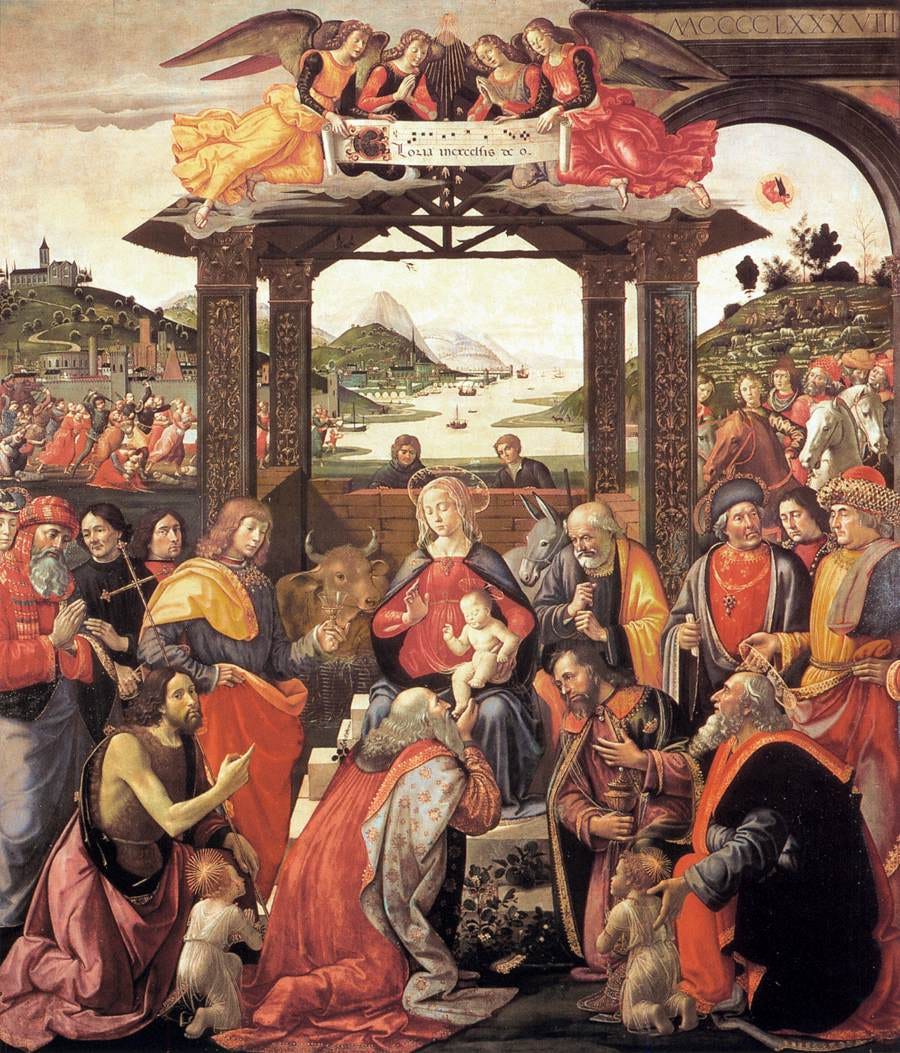
Domenico Ghirlandaio, Adoration of the Magi, 1488. The 1485 contract specified ultramarine worth about four florins an ounce within a commission worth 115 florins. The masterpiece arrived with a specification.
Florence could sustain this because it was an unusually wealthy commercial city — textiles, merchant networks, banking, credit, guilds, international trade. Venice had its maritime economy and Rome another concentration of wealth around the Church and papal government. Whether any of this should be called capitalism is a harder question, and these societies remained structured by guild restriction, inherited status and ecclesiastical property in ways that resist a clean transition from feudalism to markets. For the paintings, the narrower point is sufficient: some families and institutions controlled enough surplus to spend remarkable amounts of it on cultural production.
Why they spent it is more interesting than saying that wealthy people like beautiful things. Aristotle had described magnificence as the decorous expenditure of large wealth on public display, and by the mid-fourteenth century the idea was being applied to patronage directly. A chapel displayed wealth while converting the display into devotion, memory and legitimacy. A palace sheltered a family and turned private wealth into a fact visible from the street. Patronage was not charity. It was a conversion mechanism: money became culture, culture became authority, and authority protected money. Cosimo de’ Medici needed exactly such a defence, since spending on that scale ran against the prevailing view that private monuments were to be avoided. The loop it opened — commercial resources, political access, public generosity, cultural authority — did not by itself turn a banking fortune into hereditary rule, but it was part of how that transition became thinkable, and then durable, across three generations.
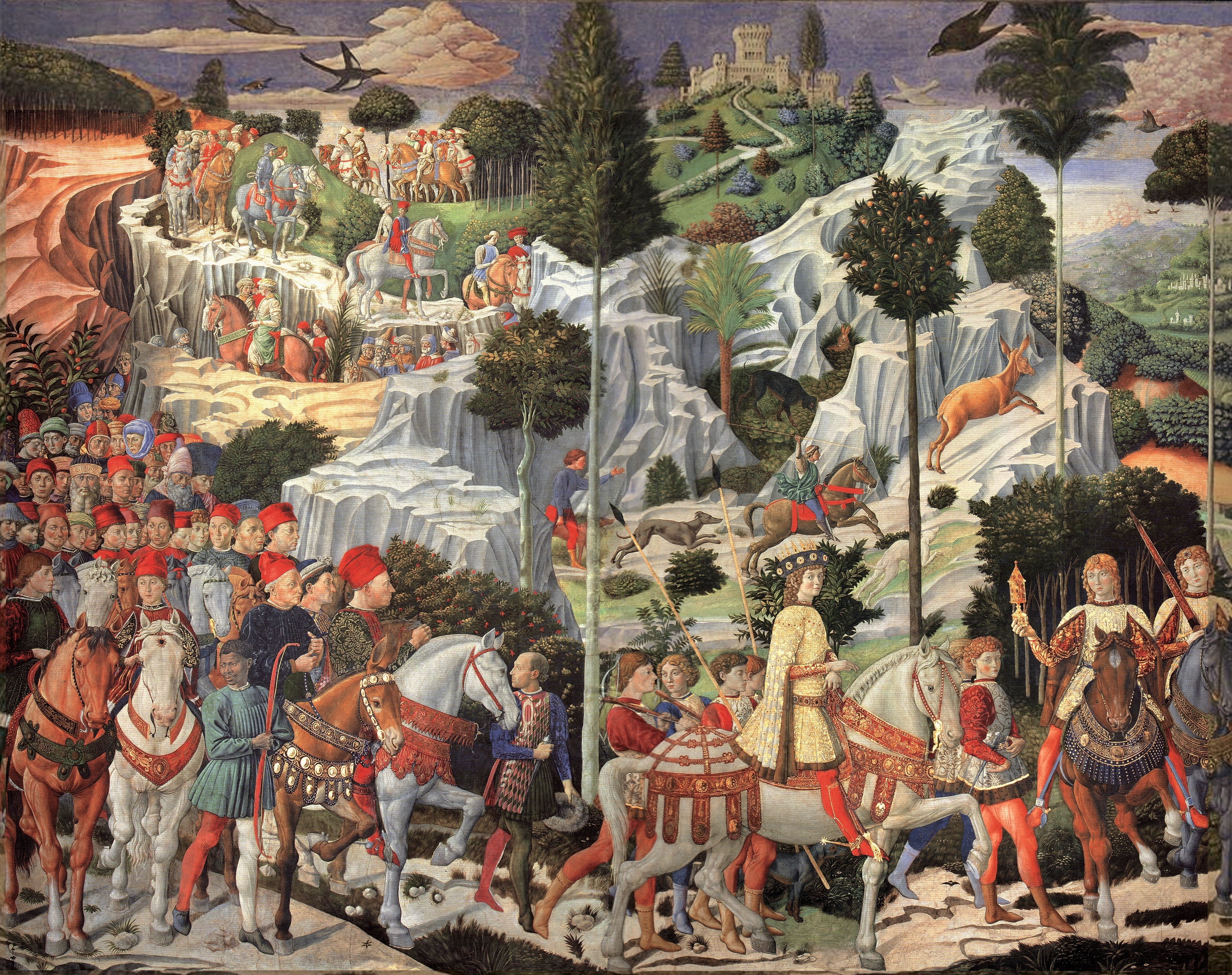
Benozzo Gozzoli, Procession of the Magi, 1459–61. Cosimo, Piero and the young Lorenzo de’ Medici rode into their own family chapel dressed as the biblical kings.
Before it was a masterpiece
Museums make it easy to forget that a painting was once a job. Renaissance workshops were not factories, but neither were they the solitary studios of later Romantic imagination. Masters managed commissions, apprentices, materials, premises, deadlines and reputation. Contracts specified dimensions, subjects, payment stages, costly pigments, and how much of the work the master had to execute personally. That last clause is revealing, because buyers already understood that different hands inside one workshop carried different values. The master’s labour had become valuable enough to contract for separately.
The museum label gives us the master’s name, and over time that name absorbs the organisation behind the work. Assistants become harder to recover while authorship becomes more precise. Something comparable happens to function. An altarpiece in the National Gallery has an artist, a date, a provenance and a well-lit wall. In its original location it also belonged to an altar, a chapel, a liturgical calendar and a sequence of activities involving priests, donors, congregations, music, incense, feast days and rules about who could stand where. A donor family might hold rights over the chapel. The image’s significance could change on particular days. Its theological meaning might depend on a sacrament performed directly in front of it.
Calling that “context” understates the relationship. Rites and ceremonies make social structures visible and repeatable. A coronation does not celebrate someone who is already king; it enacts the transition publicly. Ordination authorises one person to perform what others cannot. Marriage historically reorganised kinship, inheritance and property. Religious and political systems survive partly because people learn their roles, gestures, spaces and calendars well enough to repeat them. Culture is not a decorative layer laid over politics and economics. It is one of the mechanisms through which social relations — including hierarchy and authority — become intelligible, repeatable and, in many cases, ordinary.
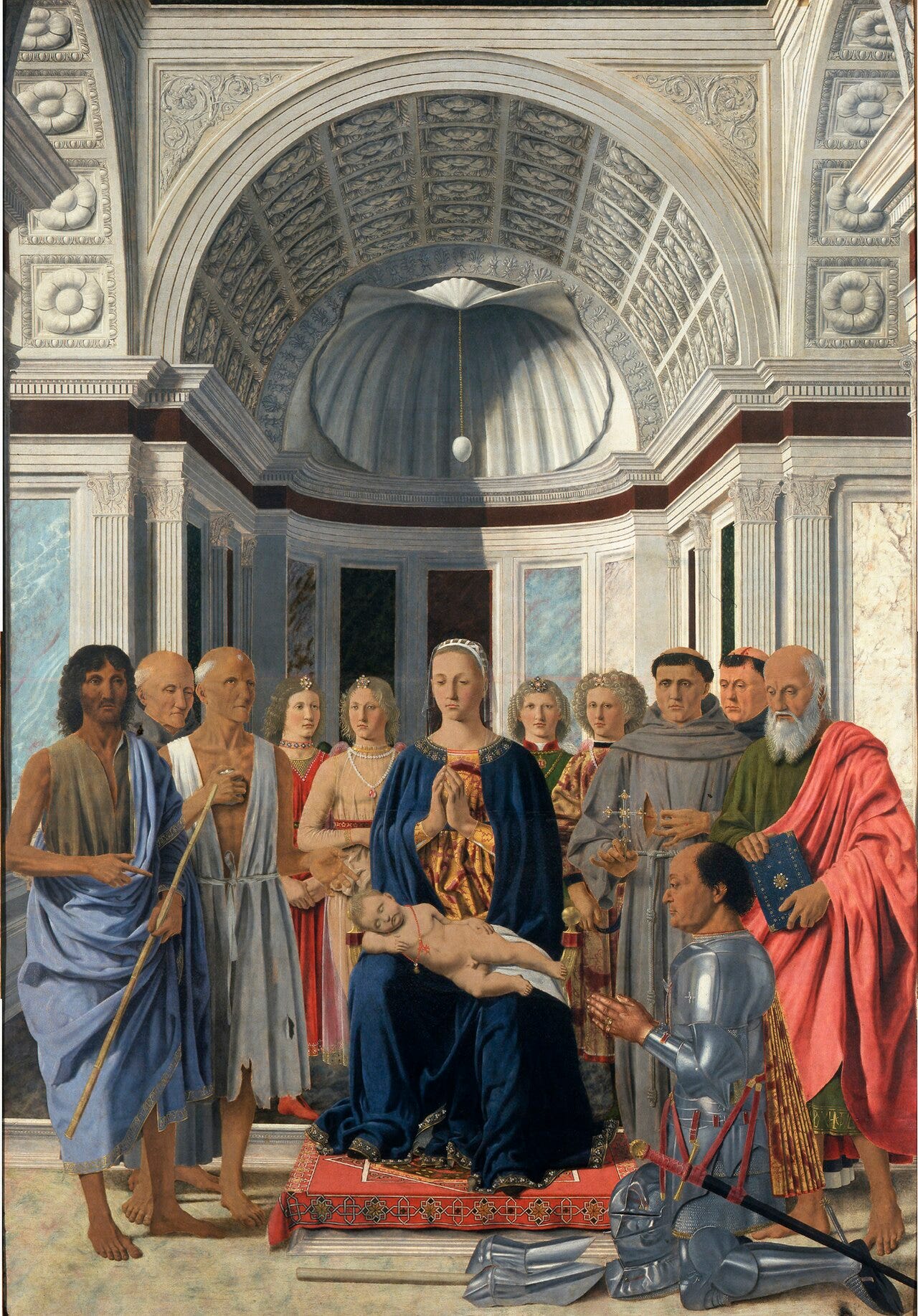
Piero della Francesca, Montefeltro Altarpiece, 1472–74. Federico da Montefeltro kneels in armour inside the sacred scene he paid to enter.
When an altarpiece enters a museum the object survives remarkably well and the protocol around it does not. The Mass stops. The donor family’s rights lapse. Political arguments that once made a saint contentious become historical notes. The object is reorganised around aesthetic attention. Nothing fraudulent has occurred, but what remains is easier to see than what vanished. The masterpiece survives more successfully than the workshop, the ritual, and the relations of obligation that once surrounded it.
The blue had travelled a long way
Natural ultramarine makes those vanished relations unusually visible, because the colour has a geography. The pigment was made from lapis lazuli from what is now Afghanistan, its preparation was laborious, and throughout the Renaissance and into the seventeenth century it remained more expensive by weight than gold. Before reaching a workshop the stone passed through extraction, long-distance trade and merchants connecting distant parts of Eurasia. Painters had cheaper alternatives such as azurite, which is precisely why a contract could specify ultramarine at four florins the ounce and make the specification enforceable.
The familiar story stops at scarcity. Ultramarine was expensive, patrons reserved it for important passages, the Virgin’s robe became its famous use. But a lump of lapis in Florence is also evidence that the Renaissance was never an isolated European awakening. Italian cities were embedded in Mediterranean and Eurasian trade and in exchange with Islamic and Byzantine worlds. Materials and knowledge moved through systems considerably larger than the cities that later became shorthand for European rebirth, and that embeddedness is among the first things the inherited version leaves out.
Vermeer makes the economics stranger, and the record around him shows how differently contemporaries could value the same work. In August 1663, a French diplomat, Balthasar de Monconys, was shown a Vermeer by a Delft baker named Hendrick van Buyten, who said he had paid roughly six hundred guilders for it. Monconys thought this absurd — he wrote that he would have considered a tenth of that price too high. Van Buyten was not a naïve bystander; he owned at least one Vermeer already by 1663 and would go on to own several more, becoming, by Delft standards, a serious collector. When he died in 1701 he left 28,829 guilders, one of the largest sums the art historian John Michael Montias found anywhere in the Delft archives.
That collecting relationship explains what happened after Vermeer’s death in December 1675. His widow, Catharina Bolnes, was left with debts and eleven children. On 26 January 1676, before a notary in Delft, she transferred two of her late husband’s paintings to van Buyten to settle 617 guilders and 6 stuivers owed for bread. It reads as a distress sale to a tradesman. It was closer to a settlement between a widow and a man who had been buying her husband’s work, and disputing its price, for over a decade.
Vermeer’s principal buyer during his working life was probably Pieter van Ruijven, or — recent Rijksmuseum research suggests — his wife Maria de Knuijt, whose own will left Vermeer a personal bequest and who may have been the more consistent presence in the relationship. Whichever of them it was, the household eventually owned as many as twenty-one of Vermeer’s paintings, close to half his entire surviving output, still together when the estate was sold at auction in Amsterdam on 16 May 1696. What that auction shows is not instability — different paintings fetching different prices at the same sale is ordinary — but how completely the record has since been rewritten. A baker once thought a single Vermeer was priced ten times too high. The name now prices itself.
The paint did not change across any of this. Critics, collectors, attribution, museums, conservation and the scarcity of a small surviving oeuvre changed the institutions through which the paintings were valued. And the pigment itself kept working long after it stopped being visible as luxury. The National Gallery owns two Vermeers of its own — A Young Woman Seated at a Virginal and A Young Woman Standing at a Virginal, painted as a pair around 1670–72 on canvas cut from the same bolt of cloth, reunited in the same room since 1910 — and the Gallery’s own technical research describes ultramarine running through both paintings well past the obvious blues, mixed into curtains and shadow where a cheaper pigment would have gone unnoticed. Elsewhere in Vermeer’s late work the habit goes further still: in The Music Lesson, on loan to the Gallery in 2013 from the Royal Collection, conservators found ultramarine mixed into the flesh shadows, into the purples of the tablecloth — and, the most extraordinary use, into the plain brown of the ceiling beams. Ceiling beams. At that point the costliest pigment available has stopped being a display of wealth and become something closer to a habit of seeing.
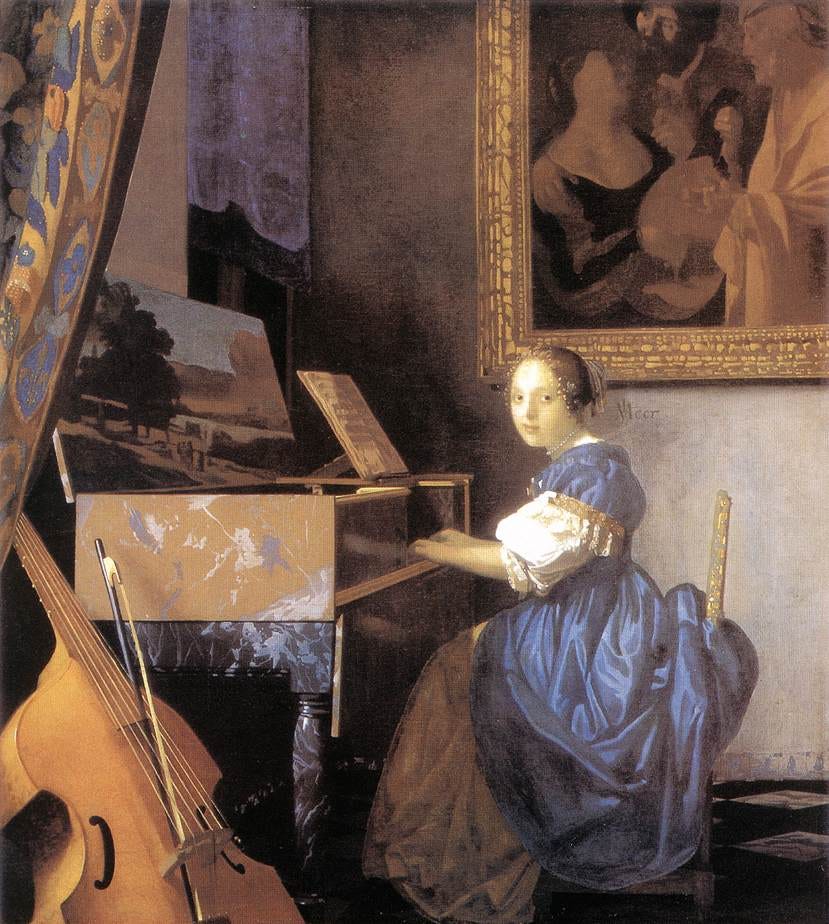
Johannes Vermeer, A Young Woman Seated at a Virginal, c. 1670–72. Painted as a pendant to a second Vermeer in the same room, and cut from the same bolt of canvas. Ultramarine turns up in both, in places a cheaper blue would have done the job.
The past was edited before it was inherited
Following the paintings backwards eventually makes the period label look strange. Fifteenth- and sixteenth-century Italians did talk about revival, and Vasari explicitly constructed a history of decline and rebirth. Humanists deliberately recovered classical texts. Yet the coherent package we now call the Renaissance, with its familiar boundaries and its implied transition from medieval to modern, was also produced by later periodisation.
Every such label performs selection. Calling something a rebirth implies that something previously died, which gives us the sequence of classical civilisation, decline, Middle Ages, rediscovery, Renaissance. Medieval history makes that sequence difficult to sustain. Classical learning had been revived more than once. Universities were medieval institutions. Gothic cathedrals required extraordinary technical and organisational capacity. Greek knowledge continued through Byzantine traditions, while Arabic scholars preserved, criticised and extended philosophy, mathematics, medicine and optics that later entered Latin intellectual worlds. Erwin Panofsky could distinguish the Renaissance from earlier renascences precisely because revival was not unique to fifteenth-century Italy.
Ancient sculpture supplies the literal version of the same process. The classical world familiar from European museums was for centuries overwhelmingly white marble, while ancient sculpture and architecture used extensive colour, gilding and patterned surfaces. The Metropolitan Museum’s own conservation research attributes the loss to three overlapping causes: burial, early modern restoration practice, and the historic cleaning methods used once objects reached museum collections. Winckelmann knew that ancient sources described painted statues; he resolved the difficulty by treating those descriptions as exceptions rather than standard practice, and his aesthetic judgment then shaped two centuries of scholarship built on black-and-white plates and uniformly white plaster casts. That is a theorist’s error, made inside a developing discipline, and it should be read as exactly that rather than as bad faith.
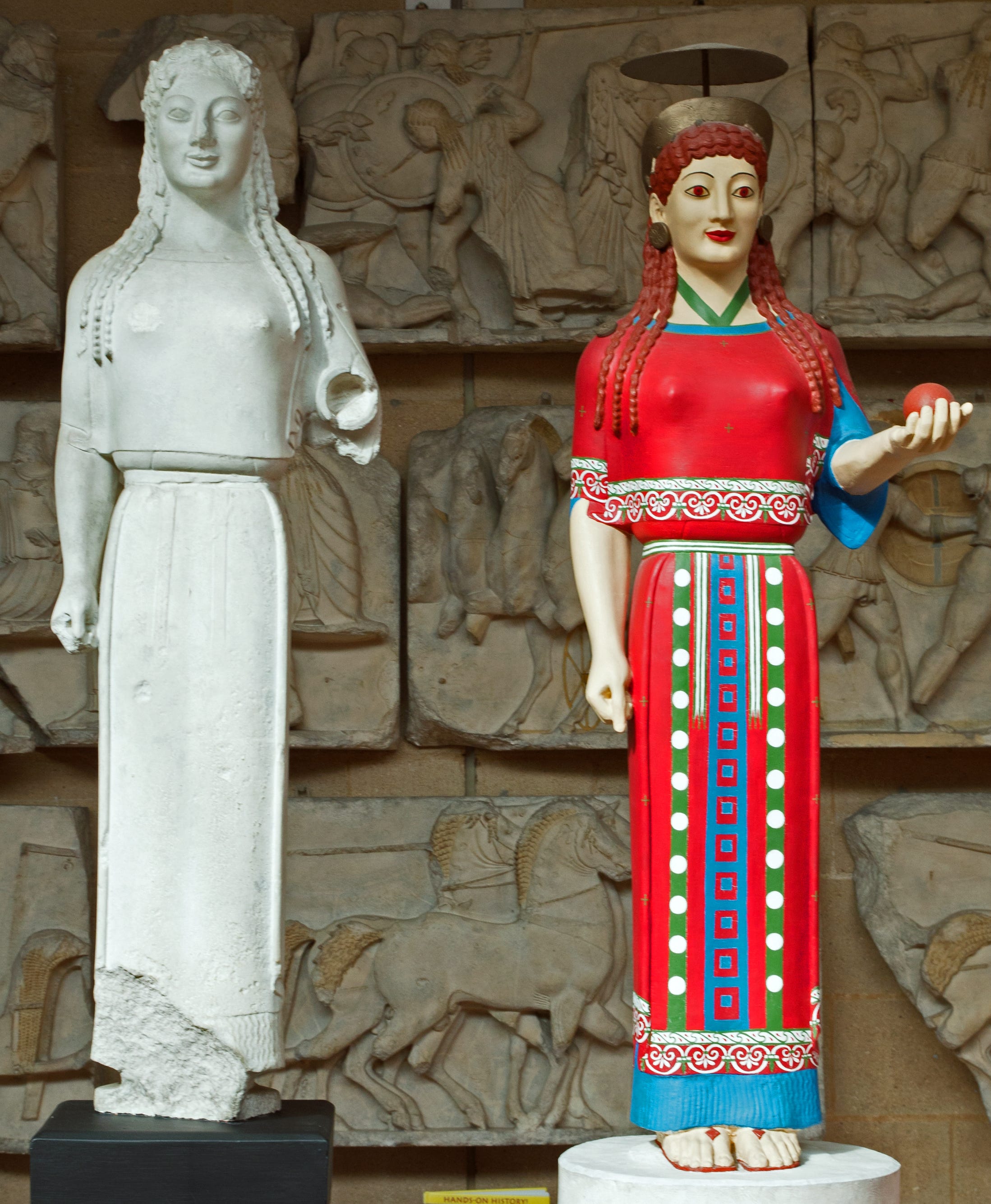
The Peplos Kore, c. 530 BC, shown as an unpainted cast beside a modern reconstruction of its polychromy. The reconstruction is interpretive — but the underlying point is established: white marble was not the original visual condition of much ancient sculpture.
Duveen’s case is different in kind, not degree. Between 1937 and 1938, sculptures from the Parthenon in the British Museum were cleaned with copper tools and abrasive carborundum, at the urging of Joseph Duveen, a donor who was funding the museum’s new gallery and wanted the marbles whiter. The work ran roughly fifteen months. An internal inquiry concluded the damage was obvious and could not be exaggerated, and the House of Commons was told in June 1939 that the trustees had taken disciplinary action. Winckelmann’s mistake belongs to the history of ideas. Duveen’s belongs to the history of institutions bending to money — a donor with leverage over a building got a physical object altered to match his taste, and the museum concealed it. Different mechanisms, same outcome: a past cleaner than the evidence supported.
The cumulative effect of many such decisions — the cataloguer who recorded the master and lost the assistants, the curator who lit the altarpiece well, the periodiser who drew a line at 1400 — was to produce a past with its contradictions removed. Workshops absorbed into masters. Ritual reduced to context. Supply chains reduced to colour. Oligarchy and church power thinned into humanism. Polychrome marble scrubbed to white.
The editing does more than simplify the past. It breaks the visible connection between cultural greatness and the concentrations of wealth, labour and authority that produced it. The achievement remains; much of its political economy disappears.
The Renaissance’s values have never lacked critics. Milton turned humanist ambition and the thirst for knowledge into a story of spiritual ruin; Blake attacked the rationalism and classical authority that followed in its name; Eliot and Yeats each located, in their own idiom, a rupture of feeling or civilisation somewhere in its wake. Ruskin came closest to naming the actual mechanism, arguing that Renaissance style set the master’s design above the workman’s hand and left ordinary labour with no creative claim of its own. All of them are arguing with the Renaissance’s values — ambition, reason, individual mastery. This essay isn’t. The argument here is not that humanism went wrong. It is that the version we inherited was cleaned of who paid for it and who built it.
What a regime does when it cannot inherit
Fascist Italy is the exception that shows what the inheritance is worth. Mussolini’s regime did not receive a usable Rome; it built one. Isolating the Mausoleum of Augustus required demolishing roughly 120 buildings across some 28,000 square metres. A parade route was cut through the imperial fora. The Mostra Augustea della Romanità marked the Augustan bimillenary in 1937 with more than three thousand objects, presenting a Roman world that was militarised and hierarchical, with Augustus as the archetype whose achievements anticipated Mussolini’s renewal of the Italian people. Roger Griffin’s description of fascism as palingenetic ultranationalism names the temporal structure precisely — decadence, then regeneration through a new order — but it does not describe the bill. That regime needed bulldozers, an archaeological service, a museum and an exhibition to produce an ancestry, because the ancestry it wanted did not yet exist in usable form.
Nothing comparable is required of anyone reaching for the Renaissance today. Mussolini had to demolish neighbourhoods and build an exhibition to manufacture a usable Rome. Contemporary revivalists inherit most of their Renaissance already assembled — catalogued, lit, and hanging in national museums, with the hierarchy intact and the cost nowhere in view. The editing is not a finished job; new scholarship, new attributions and new disputes over polychromy continue it every year. But each generation of revivalists starts from whatever the last round of editing left behind, and what it left behind gets more usable, not less.
What varies after that is not the grammar but what gets attached to it. The grammar itself is common property: Jacobin France reached for Roman republican virtue, the American founders modelled a capital on Athens and Rome, and the Third Republic did much the same. Executive Order 14344, signed on 28 August 2025 and establishing classical architecture as the preferred and default style for applicable federal public buildings, sits in that same tradition — its own purpose section invokes Washington and Jefferson modelling the capital on Athens and Rome, and it names Alberti, Brunelleschi, Michelangelo and Palladio as models. The order applies to federal courthouses, agency headquarters, all federal buildings in the National Capital Region, and any other expected to cost more than fifty million dollars to design, and it requires thirty days’ notice to the President before a brutalist or deconstructive design is approved. It is a procurement preference with a scope and a threshold. It does not become fascist because it favours columns.
The Nazi exhibition of degenerate art, which ran in Munich from 19 July to 30 November 1937 and displayed 650 confiscated works, crossed a threshold that procurement does not. Modern art was not called ugly. It was made evidence of disease, corruption, Jewishness and Bolshevism, while a Reich Chamber of Culture created in September 1933 controlled who could work at all, and a 1938 law legalised confiscation without compensation. Aesthetic judgement had become a diagnosis of the social body, and the diagnosis had consequences for people rather than for buildings.
That threshold is crossed by a specific move: when departure from the preferred form is described not as a choice one disagrees with but as a symptom of what has gone wrong with a people. “Make America Great Again” does not make that move, and it does not have to. It shares one element of that temporal grammar — a lost greatness followed by promised restoration — without that resemblance by itself placing it in Griffin’s much narrower category of fascist palingenesis, which requires the myth of rebirth to fuse with revolutionary ultranationalism. The formula works on the ambiguity alone: it requires a lost greatness without ever specifying a moment when all the desired qualities coexisted, so different people can populate the missing past differently. Calls for a new Renaissance operate identically. The difficulty of locating such a period historically is not a weakness of the appeal. It is what makes the appeal portable.
Scarcity changed form
Even if we wanted to reproduce the conditions of Renaissance cultural production rather than just its results, we could not do so by reproducing its institutions. Its binding constraints were different, and the pigment shows exactly how. Natural ultramarine was scarce because geology, transport and processing made it scarce, and a patron in 1485 had to write four florins the ounce into a contract to be certain of getting it. Synthetic ultramarine destroyed that bottleneck in the nineteenth century, and the barrier since has moved rather than disappeared — from geology and cash to, in the case of Anish Kapoor’s exclusive 2016 licence for Vantablack, a contract.
Digital abundance has relocated the same problem again. What is scarce now is attention, trust, reputation, and the economic security required to become good at something slowly — none of which appear anywhere in the version of the Renaissance we inherited, because none of them were the constraint that period was working against. A revival modelled on patrons and workshops would be solving the wrong scarcity.
What we are actually asking for
Calls for a new Renaissance often ask for the visible results of hierarchy while ignoring the hierarchy itself. The comparison flatters because the word has accumulated flattering meanings, and it accumulated them through the editing. We remember Leonardo rather than the workshops that failed, the masterpieces rather than the contracts, humanism more readily than oligarchy, rediscovered antiquity more readily than the medieval and Islamic transmission through which the knowledge actually travelled. A period saturated with political, religious and economic contradiction became shorthand for creativity and human flourishing, and it became that shorthand before anyone thought to campaign on it.
The historical Renaissance did not merely tolerate that arrangement. Its institutions often helped produce it. Wealth became magnificence. Political authority became architecture. Religious hierarchy became ritual and image. Dynastic ambition became portraiture and public memory. What looks in hindsight like a fortunate coexistence of greatness and hierarchy was, at the time, frequently a relationship of mutual production, each one making the other more durable.
That sequence is what makes the appeal cheap. Some revivalist rhetoric is not really asking for more creativity. It is asking for a cultural order in which beauty, authority, hierarchy and civilisation appear to reinforce one another.
Back in the gallery
If I went back tomorrow, none of this would make the paintings less impressive. I would still stand too close, still look for the details that vanish in reproduction, still forget the argument entirely because somebody did something with light that resists explanation. A materialist account that ends by explaining beauty away has only replaced one narrow story with another.
What would change is what else is in the room. The blue would still be blue and would also contain a mine in Badakhshan, four florins the ounce, and a notary writing the figure down so a patron could enforce it. A Vermeer would still be a Vermeer and would also carry a baker who thought his own purchase absurd and bought more anyway.
I did not lose any admiration for the paintings. I lost confidence in the word above them. What I no longer trust is the assumption that great art simply testifies to a great civilisation.
The radical question is not whether great societies produce great art. It is whether great art can make deeply unequal societies look great.
Two books behind this piece aren't online: Erwin Panofsky's Renaissance and Renascences in Western Art (1960), on how the period got its edges, and Roger Griffin's The Nature of Fascism (1991), on the idea of national rebirth this essay leans on. Worth the trip to a library.